

The Replay of our June 14th Live Stream on Finding (OR Creating!) The Freedom Movement in YOUR Community!
Here is the replay from our June 14th LiveStream: From Isolation to Action – Finding (OR Creating!) The Freedom Movement in Your Area!
Liberty Group List at: ArtOfLiberty.org/Liberty-Groups/
Etienne: Hi, this is Etienne De La Boétie2 with the Art of Liberty Foundation. Welcome to our Sunday night live stream, which is something I think we’re going to begin doing more and more of. For those that aren’t familiar with the Art of Liberty Foundation, we are a startup public policy organization exposing the illegitimacy and the criminality of government. Essentially, our thesis is that government was never intended to protect life, liberty, and property. Government is best thought of as a technique for robbing and controlling society. And as voluntarists, we don’t believe that government is legitimate, desirable, or necessary. So we are advocates of something called real freedom, and there is a real freedom movement all around the world. In some cities and towns it is much stronger than others, but there are voluntarists and libertarian and freedom-oriented groups all around the United States.
So what we wanted to do is have a little bit of an overview of how you find that freedom movement. And if that freedom movement isn’t active in your town or city, then how do you create it yourself so that you can find your liberty friends and your liberty allies? I wanted to start off by telling you why that’s so important. But before that, I wanted to introduce Counterforce Alliance, our partners in this event. Counterforce Alliance helps liberty groups grow, provides tools so that they can be successful, and provides training for people that want to take their liberty group to the next level or learn how to become a facilitator of a liberty group. So I’m going to be joined by the team from Counterforce Alliance, and we’re going to give you an overview. And with that, I think we’ll start sharing the slides. So, Haley, if you wanted to kick it off and begin sharing our deck, I wanted to get started and go over why it’s so important to have a liberty group and to have freedom groups in the United States and in the world. My example is something that happened during COVID, where we helped organize resistance to the economic warfare of COVID, the lockdowns in Santa Cruz, California.
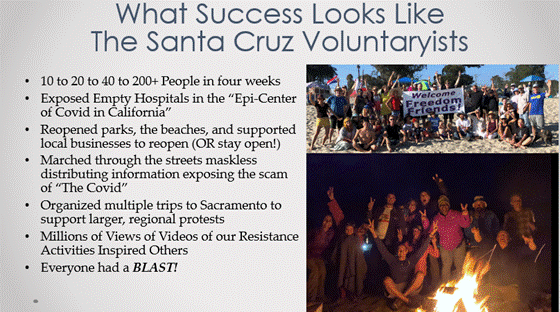
And Haley, if you could put it on the third slide, I wanted to talk about what success looks like and why this is so very, very important. So when COVID kicked off, I found myself in Santa Cruz, California, which is a story in and of itself, and people were still trying to figure out what was going on, what was happening in the United States and the world.
Myself and David Rodriguez, who many people know from the Education Options Summit or the Gatto Project, or from helping students graduate and get out of the government school system through Valor Academy, where he speed-graduates people out of the system so that they can get on with their lives and/or some kind of vocational education or other self-directed learning — we ended up at a little dinner party of about ten twenty-somethings and thirty-somethings and everybody was trying to figure out what was going on with COVID. And David and I said, well, I think we’ve got an idea: we’ve got an intergenerational organized crime problem. They’ve been lying to the country about everything, from what happened in the Gulf of Tonkin, to what happened on 9-11, to what happened with Kuwaiti babies tossed out of incubators during the—
Kristina: I want to — sorry, I apologize. People are saying that they can’t see the slides. Are they live right now?
Etienne: We are live, so they should be getting the slides, and I’ll let Dren work on that, but it sounds like they can hear me. So I’ll keep talking and keep going over it while Dren figures out the slides.
But back to my story on Santa Cruz: we knew the government and the media couldn’t be trusted about what happened in the Gulf of Tonkin, or Kuwaiti babies tossed out of incubators, or weapons of mass destruction in Iraq. So there was no reason to believe the government and the media that there was a pandemic. And so we made a decision at that dinner table, with about ten people, that we were going to organize resistance and begin investigating this ourselves. So that initial ten people began putting out feelers in the community.
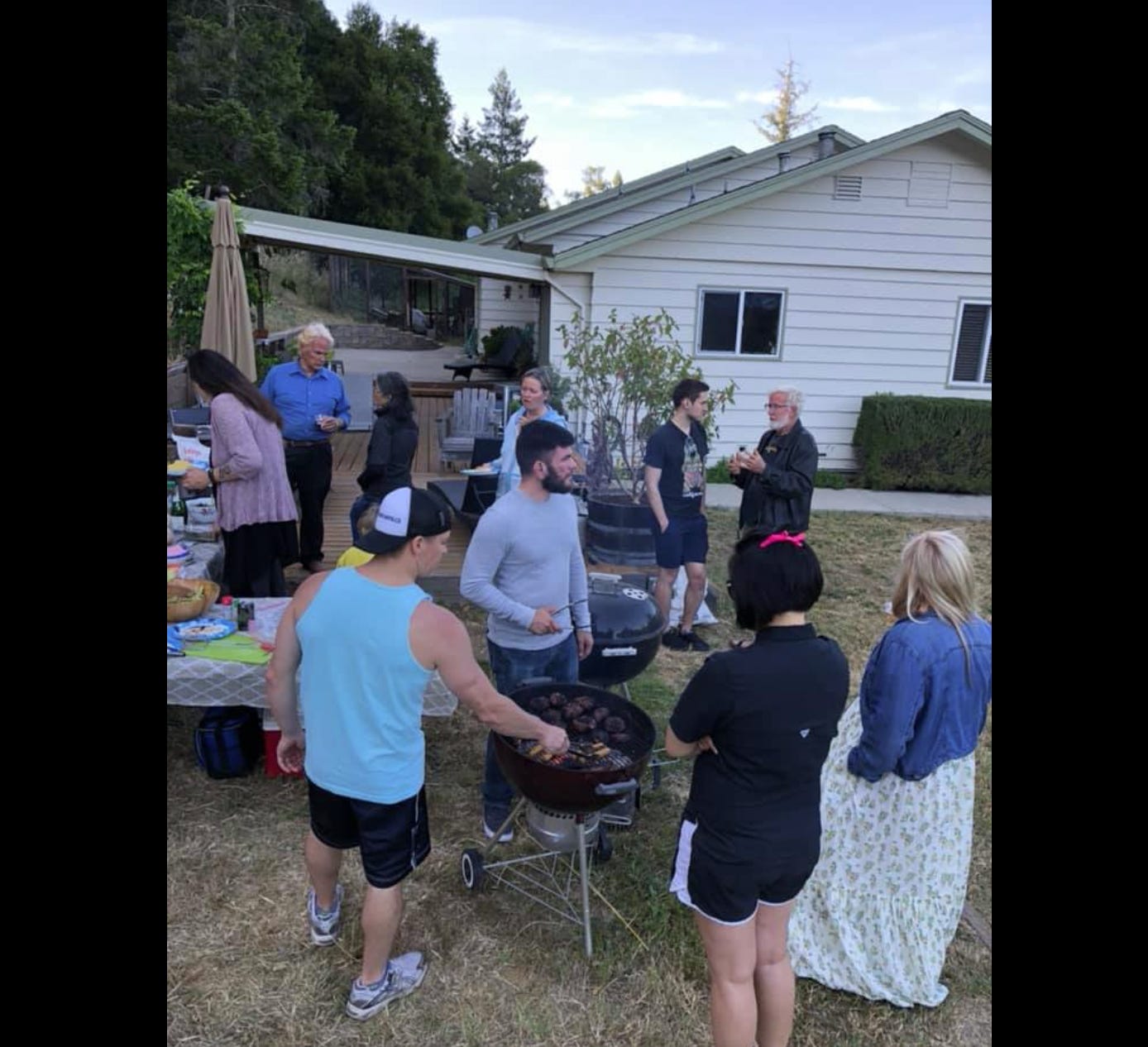
We scheduled a barbecue and a potluck at somebody’s house the next week, and the next week we had twenty-something people, and we began going into the hospitals in what the LA Times said was “the epicenter of COVID in California”. And we found empty waiting rooms, empty hospitals.

Etienne de la Boetie2 personally investigating claims of pandemic conditions at Santa Clara Medical Center in “California’s epicenter of the coronavirus” and finding empty tents, empty waiting rooms and hospital employees openly speculating that the whole thing was a hoax.
We interviewed the guy that was doing the testing. He told us flat out they weren’t experiencing pandemic conditions. He told us flat out that they weren’t even testing — not many people were coming in for testing. And if you know anything about Santa Clara in California, there is a huge Chinese community coming back and forth from the valley. If there really was a pandemic, you would see it in Santa Clara, California, because of the back and forth between the valley and China. And we found hospital employees that were openly speculating the whole thing was a hoax. So we were convinced that it was a hoax. Now, keep in mind that at the time the hospitals had emergency tents and they were full-scale pretending that there was a pandemic.
So we began exposing, literally on camera: look, these tents are empty, there’s nobody in here, there’s nothing going on at these hospitals. And we began fighting back and organizing resistance. Within a week’s time, like I said, we had twenty-something people. By the end of the third week, we had thirty-seven-plus people marching through the streets in Santa Clara, passing out leaflets, exposing the hoax of the whole thing, exposing that masks weren’t going to do anything even if there was a pandemic.
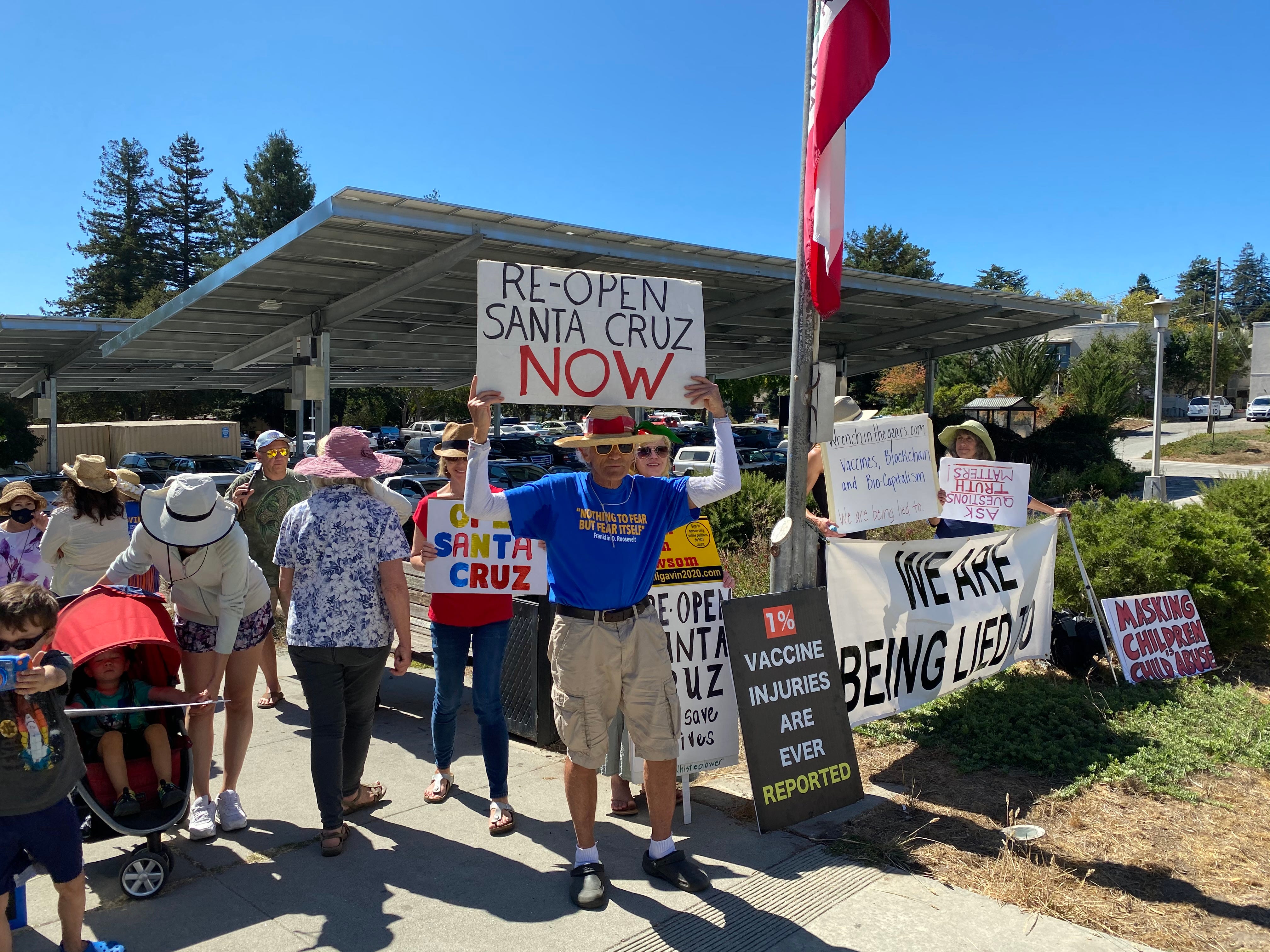
And we began trying to get businesses open, because we viewed the whole thing as economic warfare against the population. Very quickly, by the fourth week, we had over two hundred people in a Facebook group, and we began routinely turning out sixty, seventy-plus people to peaceful civil disobedience events. Some of these were free-hug events. Some of these were reopening the beaches. We would go and reopen parks. We would tear down the tape that had been wound around the jungle gyms and the equipment. They put some locks on parks; we didn’t just cut the lock off, we went with bolt cutters and cut the U-bolt off that held the lock to the gate, so they just couldn’t put another lock on it.
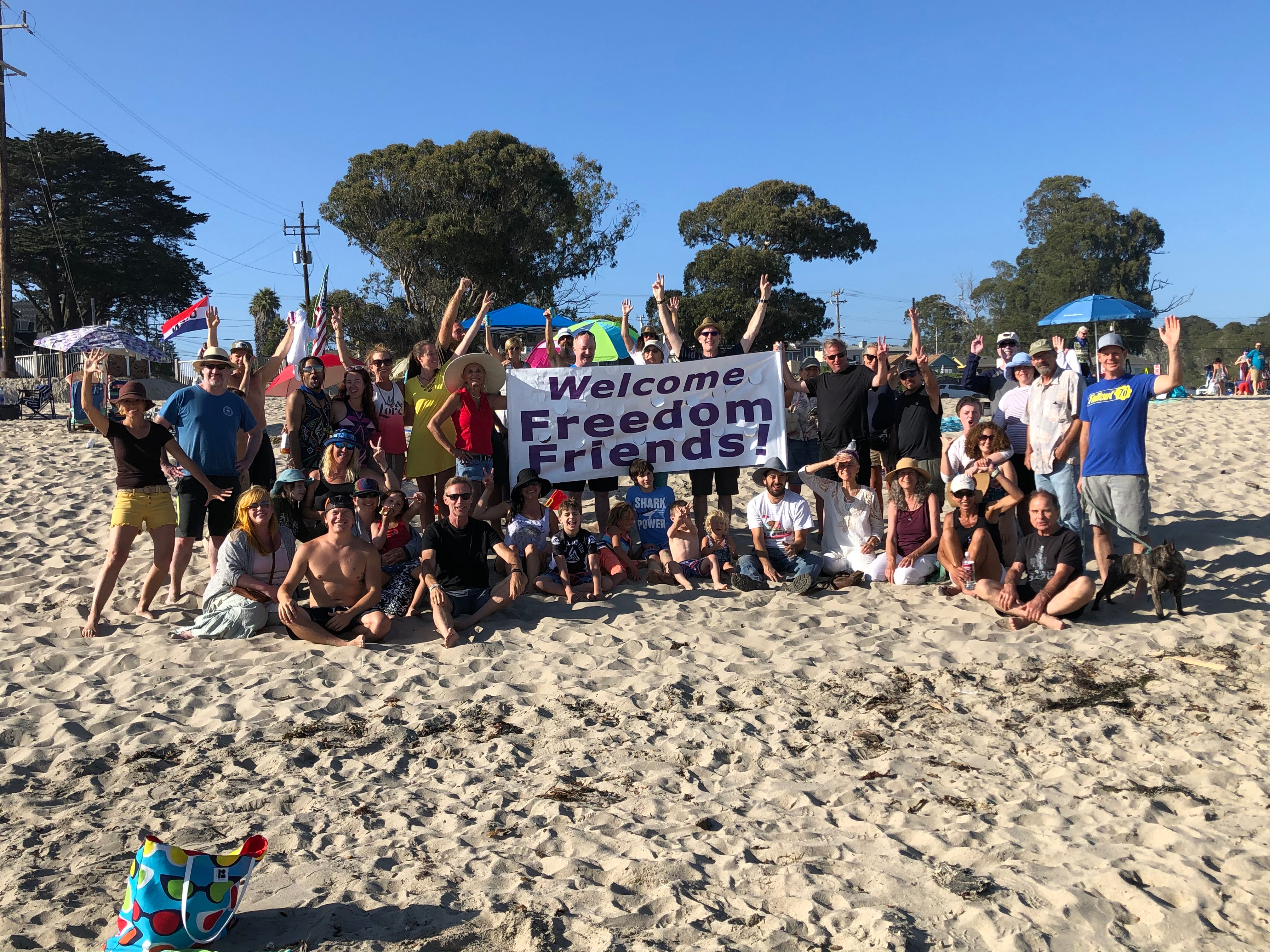
And we began having these beach parties, because they were trying to close down the beaches, and we would step forward with sixty, seventy people and a bullhorn. And we’d say, we’re reopening this beach. And sixty to seventy people would move forward, and the police would come. And the police would say, hey, y’all can’t be here, the beach is closed. And we would calmly and politely explain to the police that, no, you don’t have the right to close down the beaches — you’re the bad man, you’re threatening people with violence over something that’s not really a crime.
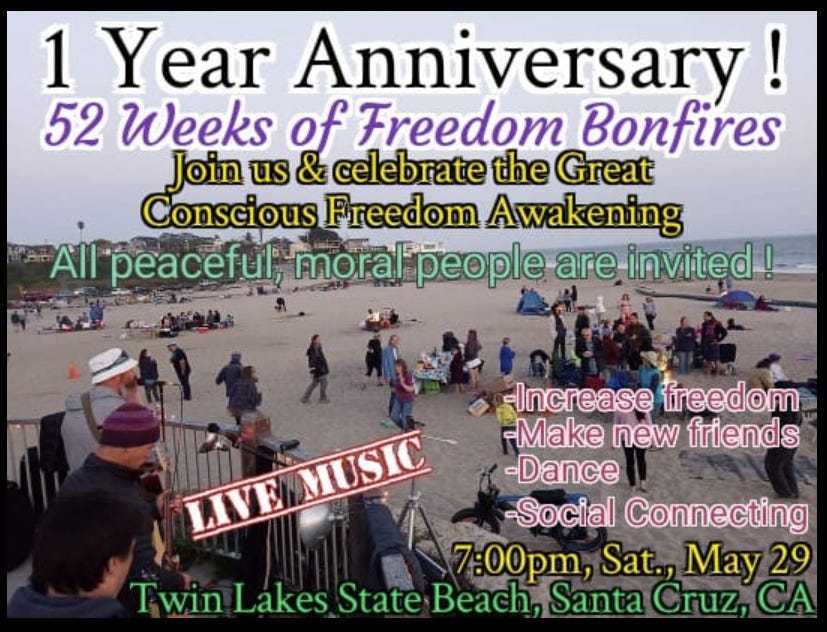
And we stood down the police eight times in eight weeks that I was there. We won. The police would get huffy, and sometimes they would ask everybody for ID and nobody would give them ID, and then they would eventually leave, and everybody would see what was going on. And we were having fun. We’re playing badminton, we’re surfing, people are singing with guitars, people are having a blast. And it became clear that really nothing was going on.
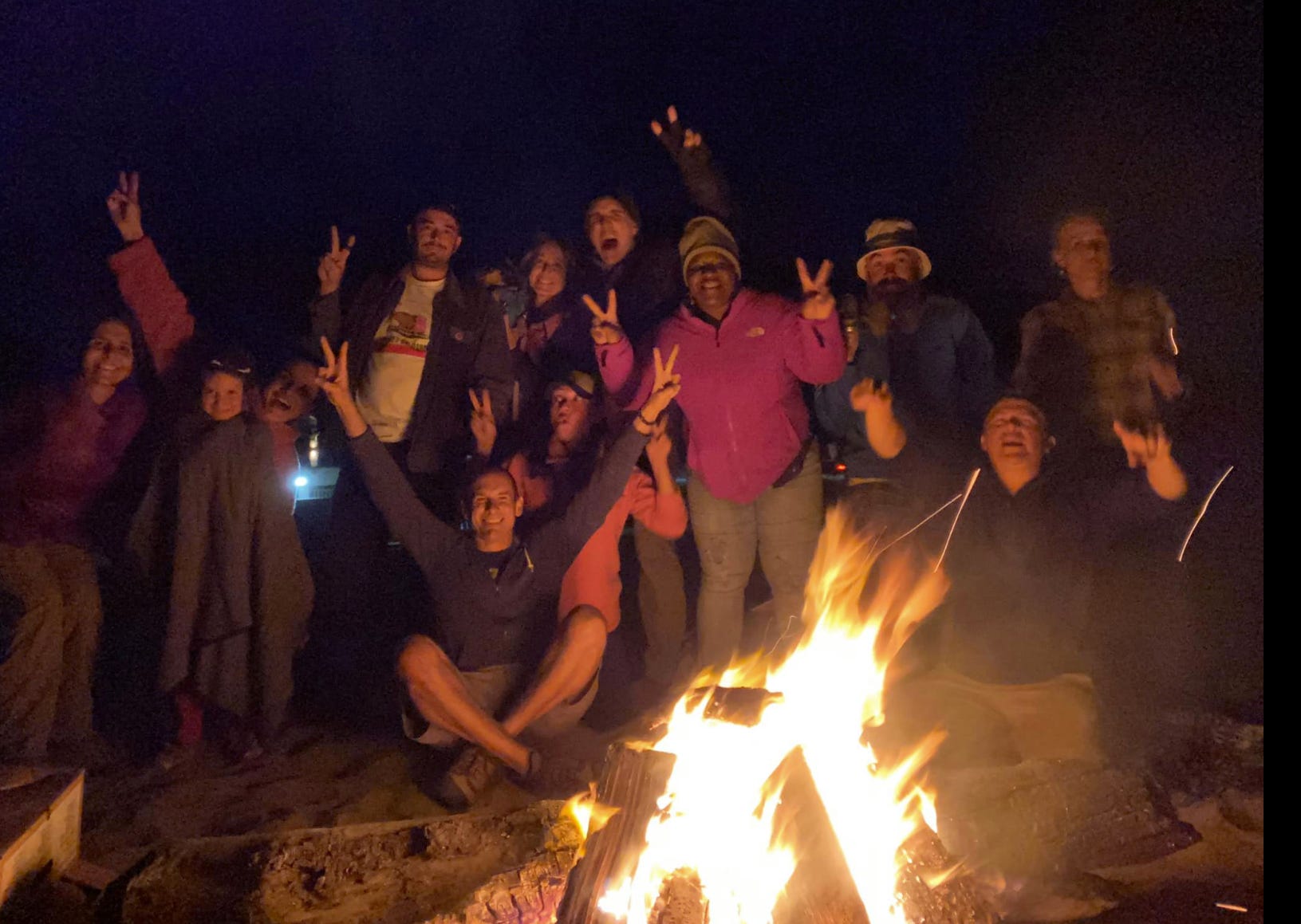
People would watch us, and over time they realized, hey, this is the group that you want to be with. These guys know what’s going on. These people are organizing resistance. And it grew.
Ultimately, the county public health officer, a woman named Gail Newell — in the LA Times, and you can go see the story today — ultimately said, we’re giving up on trying to close the beaches, we’re giving up on trying to enforce this policy, because the people refused to be governed in this way.
Peggy Hall, The Healthy American, Covers Our Mask-Free Shopping at Traitor Joes.
Now, a couple of other things that we did that I think are key: we created videos of us going into supermarkets without masks. We would go in twenty people at a time, and Trader Joe’s — their employees would try and stop us, and we would just walk around them, because there’s twenty people doing it together. And we would pick up all the groceries that we wanted, and we would do what’s called a cash drop, where we’d figure out how much money was owed and drop the money on the cash register and just take the goods. And those videos went viral, millions and millions of views, and they ultimately had to stop doing that. One other funny thing: some local organization tried to give Gail Newell, the county health officer that was imposing these draconian lockdowns when there obviously wasn’t a pandemic going on, an award.
And the Santa Cruz voluntarists pulled up on a trailer right in front of the event. And the Funky Fathers of Liberty, many of whom were in our group, have a full sound system and drum kit, and they began playing a song they’d written called — Jail to Gail, sorry, Gail to Jail — and disrupted the entire event, while the rest of our liberty group passed out information on the harmfulness of the vaccines, the experimental nature of the vaccines, and why you didn’t really want to do this, because there was no pandemic going on at all.
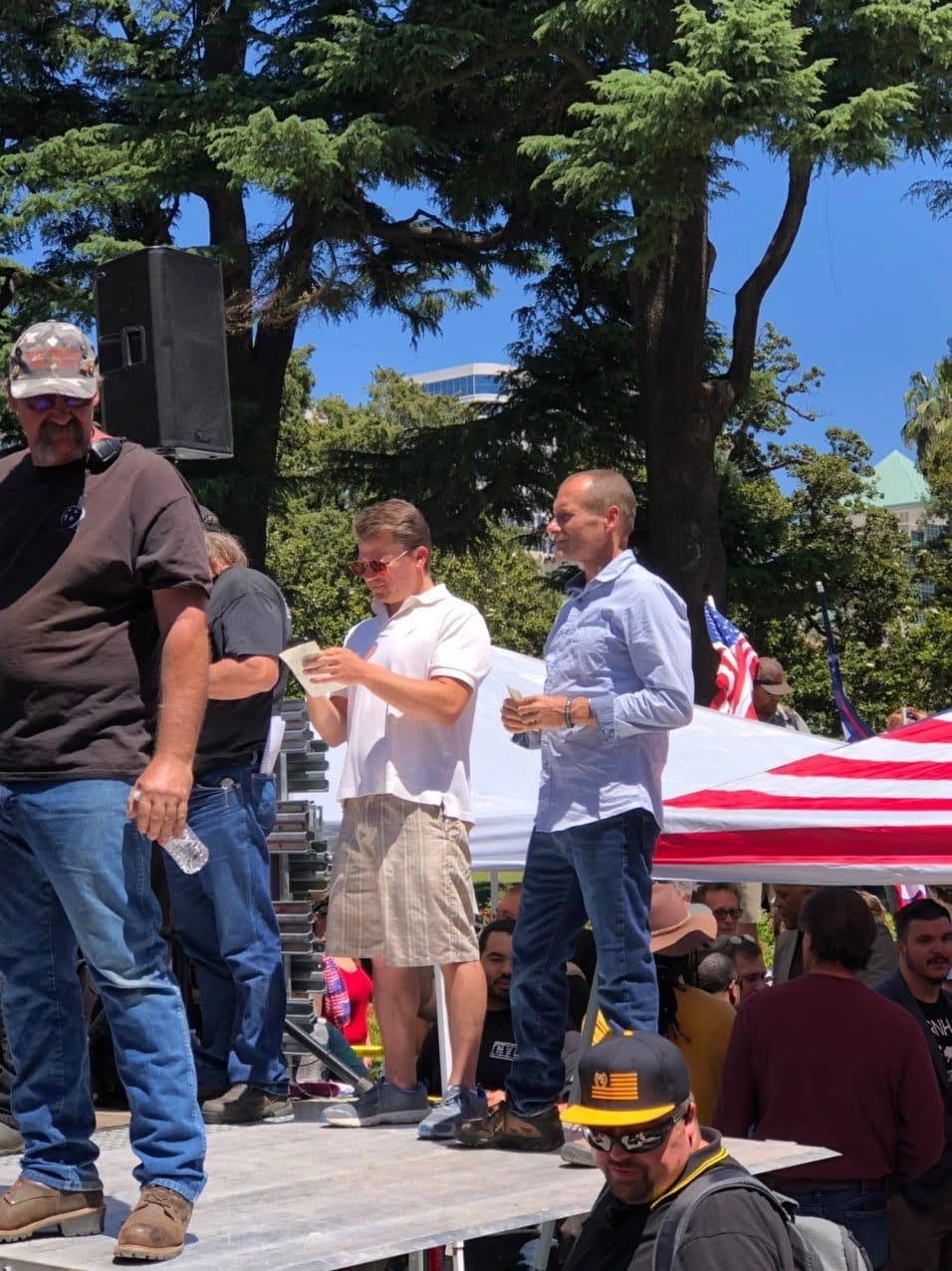
Etienne and David Rodriguez About to Speak to an Unmasked Crowd of 3,000+ at the State Capital in Sacramento in late summer 2020 – No cases of Covid were ever reported from any of our unmasked events.
Now, I would leave Santa Cruz, and in 2020 I was in twenty different states, and in 2021 I was in thirty different states, and I would meet with other liberty groups all over the country. Some of these liberty groups were libertarian. The majority of them were conservative. All of these liberty groups weren’t wearing masks. And almost every single liberty group that I went to had some connection to a hospital in that area, where some of the members of that group were either doctors, nurses, EMTs, worked in the hospital, or knew somebody that worked in the hospital. And in twenty different states in 2020, and thirty different states in 2021, I never ran into a single person — dozens and dozens of hospital employees, like I said, doctors, nurses, EMTs, et cetera — that claimed they had pandemic conditions at their hospital.
So it really was a government and media hoax designed to transfer money to these pharmaceutical companies and to get a needle into people’s arms that ended up hurting a whole bunch of people. So my point here is that having that network in your community is very, very important, should they ever try that again. But it’s also very important because it’s hard to explain to somebody what’s going on when they’re getting all of this information from every single screen — that government’s legitimate, that government’s desirable, that government’s necessary, that civilization would crumble, that it would be purge anarchy in the streets if there wasn’t a government.
And you really have to have a network of people, some of whom understand economics, some of whom understand philosophy, to really drive this point home and help people understand the freedom philosophy. So what I wanted to do is take everybody through the basics of how you do this.
If you don’t know where that organization is in your town, then the first place to start is at the Art of Liberty Foundation website at ArtOfLiberty.org. On our website, we have a tab in the About section called Liberty Groups, and we have a listing of all of the liberty groups that the Art of Liberty Foundation knows about.

ArtOfLiberty.org/Liberty-Groups/
You can go and see if there is a liberty-oriented organization in your town. We also have links to other consolidators.

There’s a group called Liberty on the Rocks, and Liberty on the Rocks has libertarian-oriented drinking events — get it? Liberty on the Rocks — in almost ten-plus cities in the United States, and very popular in Colorado, where the average chapter has hundreds of people and they regularly turn out events with fifty-plus people.
There is the Soho Forum in New York City. There is the Menlo Forum in Silicon Valley, in Menlo Park (Invitation Only, E-mail me if interested). There are a variety of very well established, and in some cases very prestigious, meetings where they’ve got world-class speakers. So you’re going to find, like I said, that list at ArtOfLiberty.org/Liberty-Groups/.

But we’ve also got links to groups like Freedom Cells, which has a map where you can either search in your hometown or post a link, and you can do this anonymously — you don’t have to put your exact address, you don’t have to put your exact name — but you can begin to network with the Freedom Cell community, who are overwhelmingly libertarian, to find those groups that are in your town.
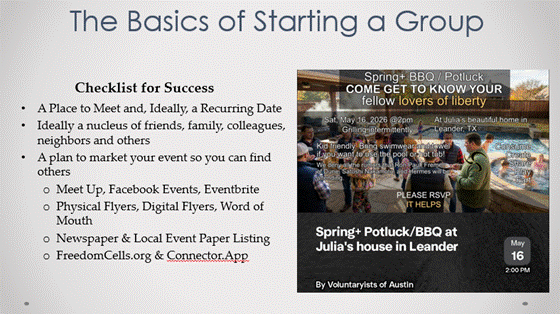
Now, let’s say that you don’t have one of those in your town. Some of my checklist of success is, number one, to find a cool place to meet, and ideally a recurring date. To get traction, you want to try and have everybody meet on the same day, whether that’s the second Saturday of the month or the third Thursday of the month, so that people can plan on it ahead of time. You get started with your nucleus of friends, family, colleagues, neighbors, and others — you reach out to your existing social circle.
You say, hey, I’m worried about what’s going on in the country. I’m worried about masked ICE goons on the street and the surveillance and the flock cameras and everything that’s going on. I wanted to get everybody together. And there’s a variety of places where you can market this event. Some of those are Meetup, Facebook events, Eventbrite. We don’t trust Meetup — we believe they’re censoring freedom-oriented events and freedom-oriented groups, so be aware of that. But I like the full-court press. I think you should do it all. You should be on every single channel that would help you find people within your area. So I call it the full-court press: be on every channel, have a Facebook event so that you can share it easily on Facebook.
But also count on the fact that it may be censored, that you may be shadow-banned, that they may not share it the way that you would want. So physical flyers are the gold standard. Having both a physical flyer and a digital flyer — this is an example of a digital flyer on the screen, and this is from the Voluntarists of Austin.
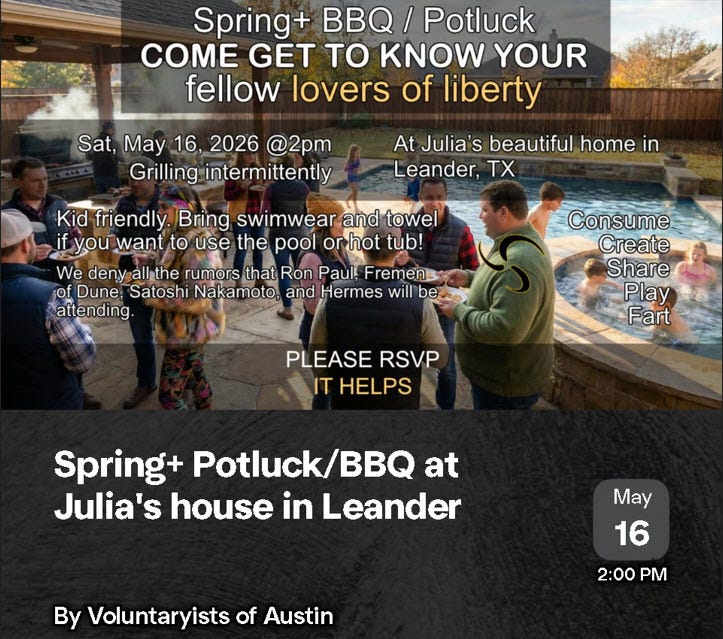
The Voluntarists of Austin, on Meetup, have a meetup group with over a thousand people in Austin, Texas. So you might be surprised that there’s already a group in your town, and that group might have a thousand-plus people in it, like the Voluntarists of Austin.
A digital flyer is simply something that can be shared — the details of the organization. A website is great, but if you don’t have a website, then the Meetup page, the Facebook event page, your Facebook group — whatever it is, you need to have some kind of landing page.
Counterforce Alliance will take you through the tools that they have to help you organize a group as well, and we’re going to get into that in a little bit. But you want to be able to share it. The physical flyers go into any place that’s got a community bulletin board — coffee shops, comic book shops, the cool hipster area in your town, bars, pubs. Everybody knows their town and where people like to gather and where those would be successful. But plan on having a digital version as well, so that not only you can share it, but your friends, your colleagues, your nucleus of the group can text it to their friends and colleagues, and you can share it through Telegram and SMS and Facebook and those avenues as well.
Almost every newspaper has a “this is what’s going on on the weekend” or an events section. Sometimes those are free to list your event in, and sometimes those are very low cost. But again, I recommend using every venue. Most people have a local what’s-going-on-in-the-concert-scene-and-the-bars-and-the-pubs publication. In Memphis, where I live, it’s called the Memphis Flyer — those are the free publications that you find in the free bins at bars and restaurants and taverns and things like that. They have event listings as well.
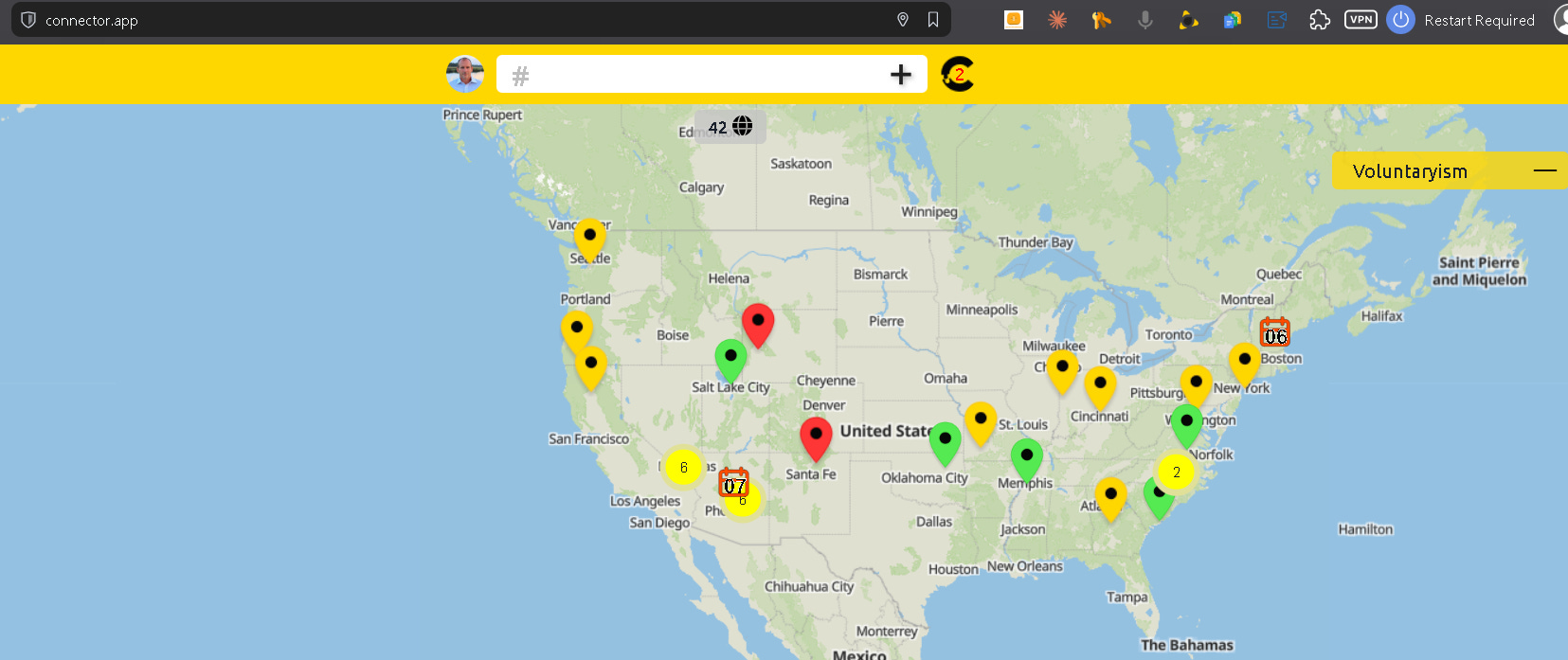
Connector.App Allows You to Search for Affinity Groups and People In Your Area
Give yourself a month. Once you start, start with the things that have the longest draw time, like an event listing in the newspaper, like an event listing in the local what’s-happening paper, and then build to that date with the things that give you the best results. And then, like I mentioned, Freedom Cells and the connector.app.
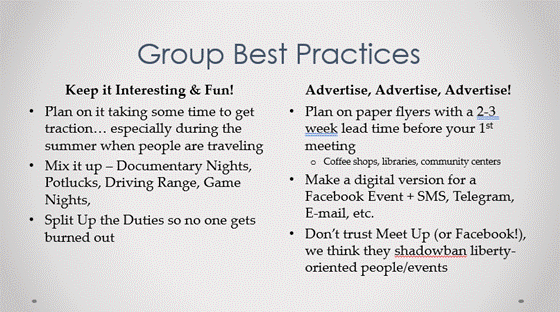
Haley, take me to the next slide. So that’s really the best practice for getting your group off the ground: marketing it effectively and getting to people that are there now.
So now you get people there, people show up. And now what do you want to do?
Well, number one, plan on it taking some time – Your first one might only have five, six, seven, eight, nine, ten friends. Be in it to win it, be in it for the long haul, especially if you’re starting it in the summertime where people are traveling, where people are on vacations.
Mix it up – Sometimes have speakers, sometimes have a documentary night, sometimes have potlucks. Don’t just make it about the problems with flock cameras in your area, or inflation.
People come to this because they’re concerned about what’s going on with the government. They stay because they like the people and they have a good time and they begin to build friendships.
Just keep that in mind. You want to make it welcoming for people. You want to make it so that people want to come back and want to be with the people. That’s how you’re going to attract people that other people want to be around, and that’s how you’re going to make it cool.
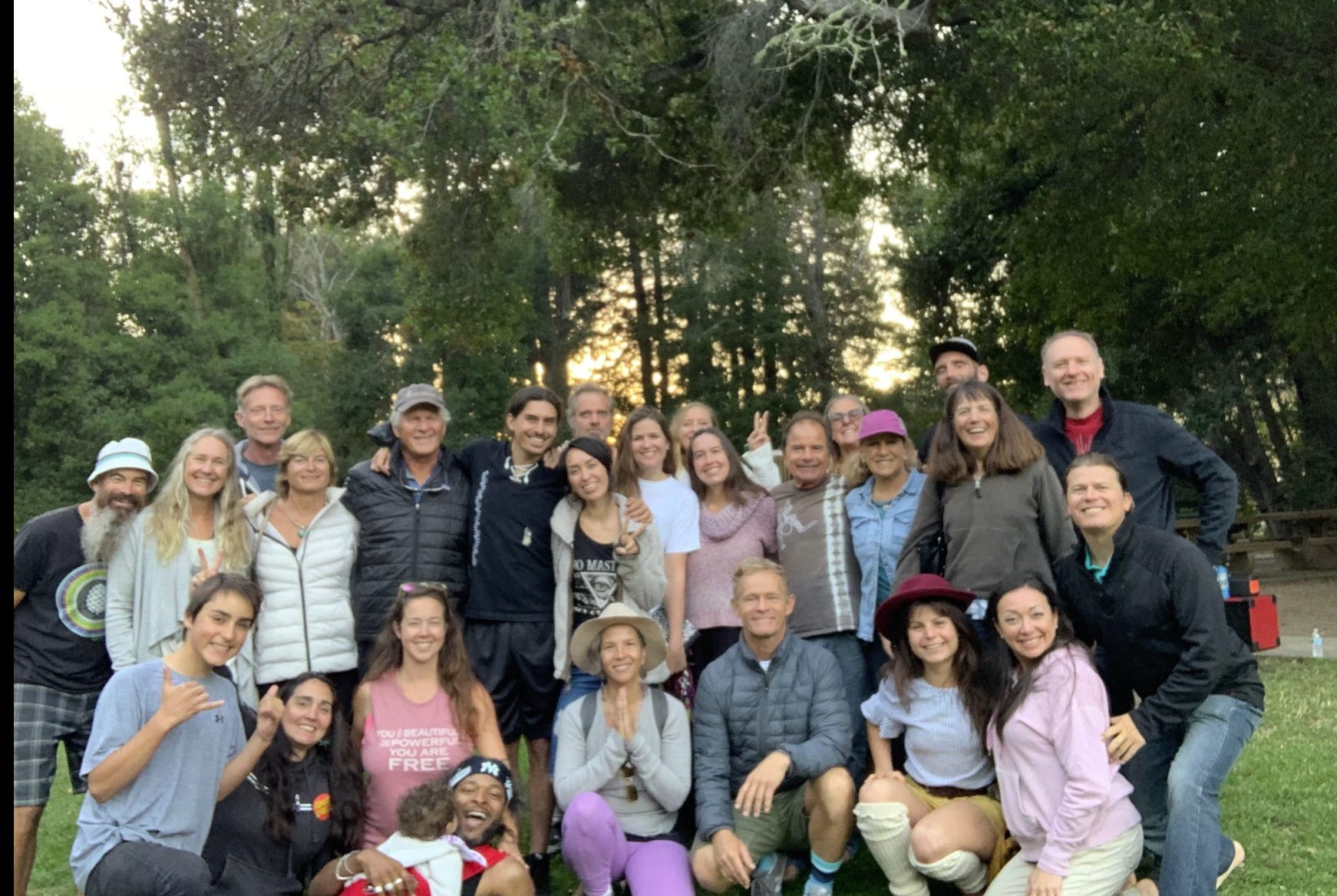
And that’s what we did in Santa Cruz — it was the cool kids’ club, and people wanted to be part of it. They realized that, hey, the government’s lying, there’s nothing to be worried about, these people are having a blast, they’ve been doing it for weeks, none of them have COVID. I want to be with those people. I don’t want to be locked in my apartment by myself.
Split up the duties so that no one gets burned out – If you’re going to have a calling tree, don’t have the same person do all the calls every week. Maneuver the duties so that one person’s in charge of marketing, one person’s in charge of putting up flyers, or whatever it is. Create a team. And that’s really my advice there: make it as fun as possible. That’s why our group thrived. That’s why we had so much success — people wanted to be a part of it. They had a good time, and we had a blast doing it. So everybody else was locked up in their homes, and we were having liberty bonfires.

So now what I wanted to do is introduce Haley with Counterforce Alliance. She’s going to tell you a little bit about Counterforce Alliance and how they create and help people start groups. They provide tools for groups, and like I said, they can help train you to be an effective facilitator and a group leader, if you so desire. So I’d like to turn it over to Haley with Counterforce Alliance.
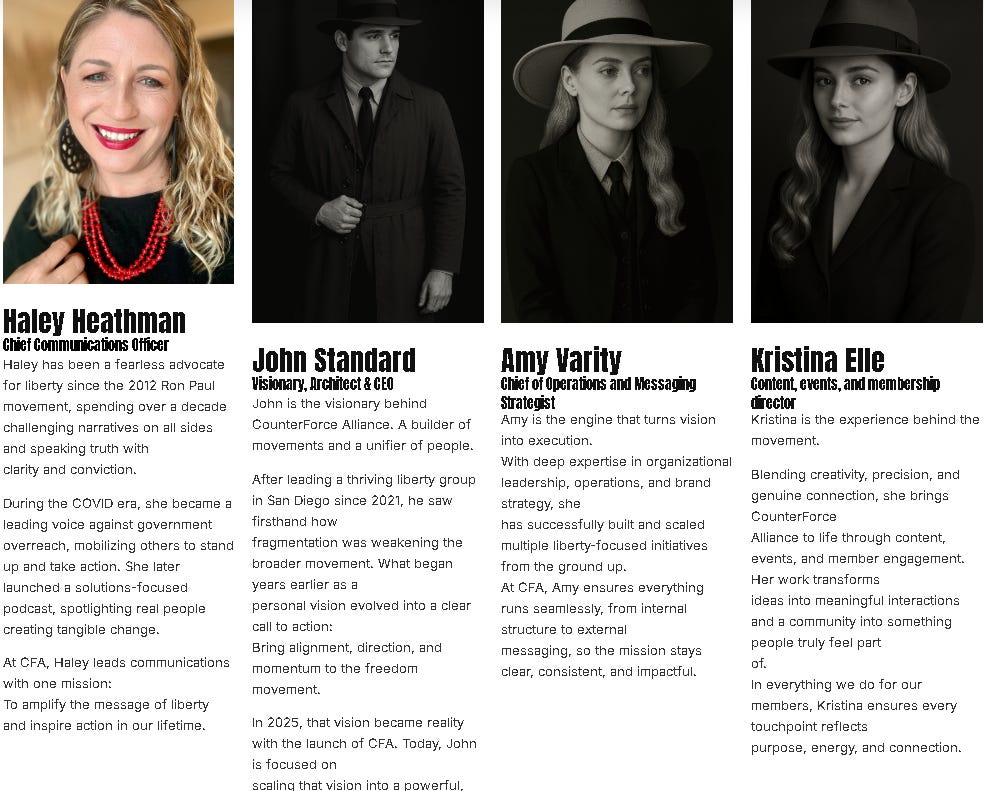
Haley: All right, thank you, Etienne. So what I’m going to end up having to do — can you screen share? I stopped screen sharing. Can you screen share the PowerPoint presentation from your end?
Etienne: Let’s see. Yeah, I just gotta give it up for a second. But go ahead and introduce yourself while I do.
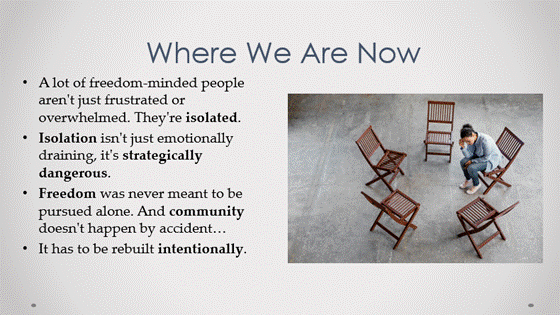
Haley: So thanks for that great example of what you guys did in Santa Cruz — it was inspirational. And I think what we’re going to talk about from our end is how we can replicate that for everybody, because that was a learning moment for all of us about how we failed as a liberty movement. You guys did a great job, but for the most part we were behind the eight ball when it came to organizing and activism at the biggest moment of our life — tyranny here in the real and now, and not just some hypothetical future — and how we can make sure that that never happens again. So I’ll just piggyback off of what you were talking about — where we are now in the freedom movement, and the Substack article that we wrote about isolation and action. So right now, a lot of freedom-minded people are frustrated or overwhelmed, or that’s what they’re feeling, but that’s really just a cover for feeling isolated. And isolation is not just emotionally draining, it’s strategically dangerous. We saw that during COVID. You guys managed to solve that problem, but most of us didn’t. We felt like one man on an island. We felt like we didn’t have support of any kind, like we were the only sane people around here while everybody else, the world, had gone insane. We felt like the only sane ones in the insane asylum. But that’s strategically dangerous. What we’ve discovered is that freedom is not meant to be pursued alone. And community doesn’t happen by accident — it happens by intention. And that’s where our aim is at Counterforce Alliance: to build community intentionally, and not by accident. So here we go.
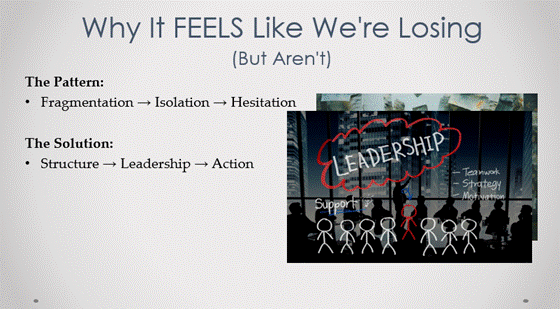
I’m going to get started on slide seven, about why it feels like we’re losing, but we aren’t. A lot of people in our community, let’s face it, have taken the black pill. And let’s be real — it’s hard not to see what’s going on in our country and not feel a little bit demoralized. We see what’s happening, we see the news, we have this feeling that evil is winning, or that the globalist agenda is just unstoppable. Etienne, can you get to slide seven?
Etienne: Yeah, I’m on it. Yeah, that one.
Haley: And keep scrolling forward. So the reason it feels like harmful agendas are winning is not because they’re more numerous, but because they operate in coordination. They move in tandem and they reinforce one another. It’s been an observation in politics for quite a while that those on one side of the political spectrum tend toward collectivism, and those on the other side tend toward more radical individualism. And most of us here tend to fall on the latter side of that, the radical individualist side. Meanwhile, the freedom movement, despite being filled with intelligent, principled, well-intentioned people, often operates in isolation. Everyone is doing something, but it often feels like we’re just shouting into the void, like we’re one man on an island. And we rarely act in unison together. I always joke that anyone who’s been in the freedom movement for more than five minutes and has ever tried to organize something to affect change knows it’s a bit like herding cats — it’s rough. But that’s not a sign of weakness. It just means that we’re fragmented. And fragmentation is the real obstacle, not a lack of awareness. I dare say there’s nobody here on this stream that’s not painfully aware of the problems we’re facing as a society. So the pattern that we get into is fragmentation. And fragmentation leads to isolation. And isolation leads to hesitation, which is just a combination of uncertainty and a lack of direction. And that equals stagnation. We just don’t end up doing anything, because we don’t know what to do. And so the solution is structure, leadership, and action. So the root problem is fragmentation. We’re going to talk about that.
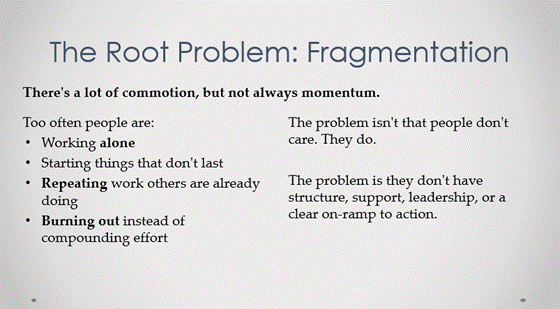
So on slide eight, the fragmentation problem. Why does it seem like the freedom movement is fragmented if so many are working hard to make it succeed? If we take a step back and really look at what’s happening, there is a lot of commotion. There’s noise, there’s energy, there’s conversation, but what we’re lacking is momentum. And that’s an important distinction, because momentum requires people moving together in a shared direction. Right now it seems like everybody’s just trying to do their own thing, and it might even be something meaningful, something important, but without support it’s hard to sustain. So you have people out there who are either knowingly or unknowingly duplicating work others are already doing. Again, it might be well-intentioned, but it ultimately leads to more fragmentation. You’re siphoning support off from one area and bringing it to the other, and then nobody’s able to reach critical mass on any one initiative or endeavor. And over time, that leads to burnout. So ultimately, this isn’t a lack of care. That’s not the problem. It’s not that people don’t care — people do care deeply. They’re informed, they’re engaged, they’re trying, but there’s no clear structure, no consistent support, and no accessible leadership. So all that energy stays fragmented. And when the energy is fragmented, it struggles to build into anything lasting. And that’s the root problem that we’re here to solve.
Etienne: And I’ve got it on “fragmentation leads to isolation” now.
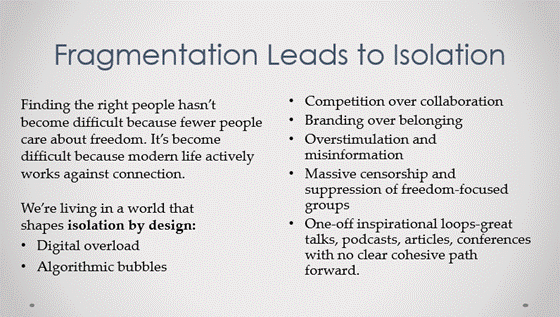
Haley: Yep, that’s right. So carrying on about the fragmentation problem: it’s not that people don’t care about freedom. People are researching, they’re listening, and they’re trying to understand what’s happening, probably now more than ever before, thanks to our digital age. And the proof of that — just look at the overwhelming number of podcasts, articles, conversations, conferences, Substack blogs, et cetera. All this indicates that people are paying attention, but there’s something missing. Despite all this information, despite all the awareness, it hasn’t translated into coordinated action. And again, this leads to that fragmentation problem. This fragmentation is aided and abetted by the pitfalls of our modern age. All the digital media, in one way, is a blessing — we’re able to stay more aware and informed than ever before — but it has nevertheless kept us in a cycle of consumption rather than connection. And the paradox here is that, despite having the world at our fingertips, quite literally, these little algorithmic bubbles that we find ourselves in actually make our world feel smaller, not bigger. And on top of that, we have to worry about things like misinformation, which is so much harder to discern in the age of AI. We’re still dealing with the issue of censorship, especially for groups like these trying to organize around freedom and liberty. So ultimately, people start to feel alone in what they believe, even when millions of others feel the same way. And when that happens, we get stuck. We get stuck in these loops where we’re inspired for a moment — oh, that was a great podcast, oh my gosh, he really nailed it; or we hear a great talk, we read something powerful, that was a great Substack article you wrote, I totally agree, you hit the nail on the head — but then there’s no clear path forward. There’s no place to bring that energy, and so it all fizzles. It fizzles that energy, that momentum, that inspiration. And then over time, that fragmentation, that fizzling of energy, leads to isolation. And isolation is what keeps movements from forming, even when there’s a desire to act. And that’s what we’re here to overcome together.
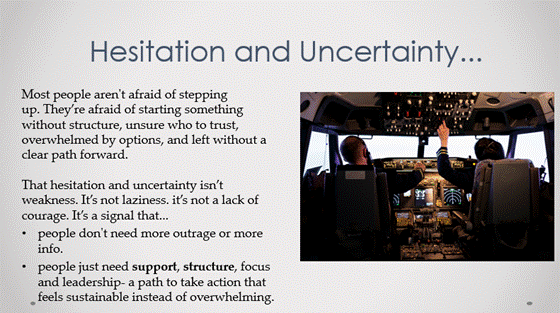
So, hesitation and uncertainty. When we get into this fragmentation, isolation, hesitation cycle, this is where most people get stuck. The hesitation gets misinterpreted as apathy or blackpilling. It can look like people aren’t stepping up, like they’re disengaged or just not willing to get involved — like, what’s the point? But that’s not actually what’s happening. Most people aren’t afraid of showing up, but they are afraid of stepping into something that feels unclear, unsupported, or unsustainable. And what most people are doing is making an unconscious cost-benefit assessment, or, as I like to say, an effort-to-reward ratio. I like to weigh that out in my mind. Say, for example, 5G cell phone towers are your area of concern. You’d say, yeah, I want to do something about these 5G cell phone towers in my neighborhood, but I don’t know anyone else who’s doing anything about it, and me going to my local city council meeting by myself isn’t going to do anything, so why bother? That’s the attitude most people have. So when it looks like nobody else is doing anything about this, or whatever little group is trying to do something is poorly organized, then hesitation becomes a natural response. And this isn’t weakness, and it’s not laziness, and it’s certainly not a lack of courage. But it is a signal — a signal that what we don’t need is more outrage and we don’t need more information. What we need is support. We need structure. We need leadership. And most importantly, we need a clear, grounded path to take action, one that feels sustainable and not overwhelming. And when that exists, the hesitation starts to dissolve, and the uncertainty shifts from clarity into direction.
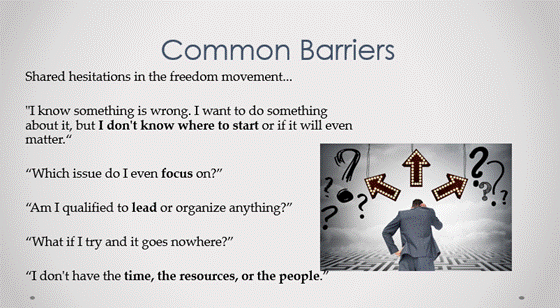
So, our common barriers. What are some common barriers or shared hesitations out there in the freedom movement that prevent people from taking action? There are lots of them, but the main ones boil down to three things. Some people say things like, well, I know something’s wrong, I just don’t know where to start. Exactly — there’s just so much, where do we begin? Or another one is, which issue even matters the most? Again, there’s so much, where do you start? Which issue do we tackle first? What’s the low-hanging fruit? It’s hard to know. And there’s so much that we all get pulled in different directions. For one person it might be digital privacy, another medical freedom, another food sovereignty, things like that. So we’re all being pulled in different directions. And then one of the big ones is, am I the right person to do this? Who am I? I’m just Haley Heathman, what am I supposed to do? And underpinning all this is an unspoken fear of, what if I try and it doesn’t go anywhere? That’s a common fear. Maybe we’ve already seen it happen somewhere in our own circles, where someone pours a ton of time, energy, and money into an endeavor and it never takes off. Despite all the effort, and you really try, it’s like a failure to launch. Or maybe they do gain traction, but still, despite their best efforts, they’re unable to achieve the goal they set out to achieve, and that leaves you feeling even more demoralized than before. And these aren’t excuses. These are real, honest reflections of what it feels like to stand alone without a clear path forward. But what that tells us is that it’s not that people are unwilling. It’s just that they’ve been left without a way to step in that actually works to support their efforts.
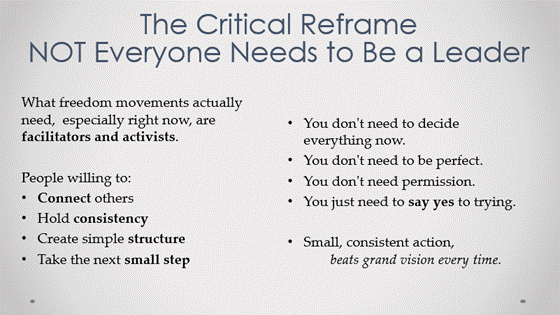
So, the critical reframe. In order to get people out of this defeatist thinking that prevents them from even getting started, this hesitation that we’re talking about, this is where we need to do a mindset shift. We need to think about things a little bit differently. And one of the big ones we need to start with is that not everyone needs to be a leader. Everybody feels like, well, I can’t take this on. But that’s not actually what we need. We do need some of those, but, as they say, too many chefs spoil the broth. So what we need in the freedom movement, actually, is more facilitators and activists. We need people who are willing to connect others, to create a little structure, or simply take the next step. Because, let’s face it, the real momentum doesn’t come from one person having all the answers. It comes from many people doing small things consistently together. You don’t have to have it all figured out. You don’t have to be perfect. You don’t need permission. You just have to be willing to say yes. You just have to be willing to try, because it’s those small, steady action steps — especially when you’re in a supported team environment — that are way better than trying to delegate tasks and figure it all out on your own.
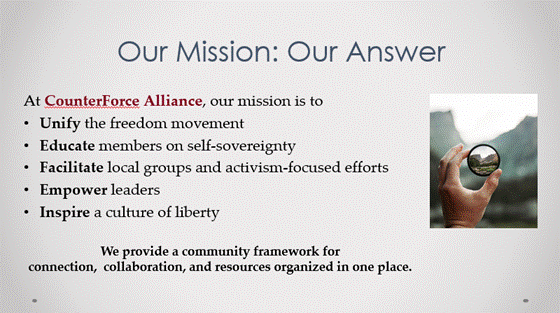
And so that leads me to our mission and who and what we are. What is Counterforce Alliance, and why are we here talking to you today? I’m Haley, and I’m joined here with John, Amy, and Christina from the leadership team, to talk about Counterforce Alliance’s mission and vision for the freedom movement. At Counterforce Alliance, our mission is fivefold. Number one, we want to unify the freedom movement. We want to bring together individuals and local groups under a shared purpose, so that we, the people, move from scattered effort to coordinated collective impact. Two, educate. We want to educate members on self-sovereignty and independence. We want to provide access to trusted knowledge, tools, and experts, so that people can build more independent, resilient lives without having to figure it all out on their own. Three, facilitate. We want to facilitate local groups and activism-focused efforts through task force teams, creating simple, accessible infrastructure for communities to organize, communicate, and take action together at the local level. Four, empower. We want to empower leaders at every level, and equip everyday individuals with the mindset, skills, and support needed to step up, lead, and sustain meaningful efforts over time. Five, inspire. Of course, we want to inspire a culture of liberty, as we know politics is downstream from culture. So beyond just practical solutions to our everyday problems, which of course is important, we also want to create a culture that values freedom. And we can do this through things like visual arts, music, short- and long-form videos, gaming, and everything in between. So in short, we provide the structure, connection, and support that turns intention into aligned, consistent action, all in one place.
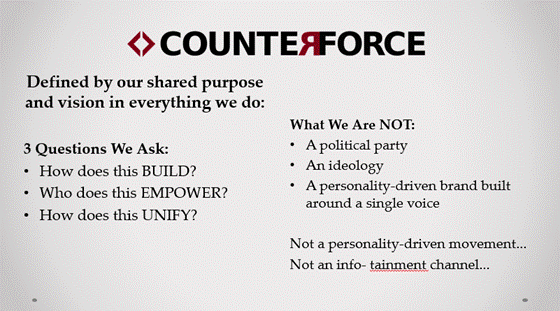
So, our purpose. Everything we do is grounded in a shared purpose, a very clear filter. And we’re always asking some of these questions: Does this build something real? Does this empower people beyond just talk? Does this unify instead of divide? Because if it doesn’t do those three things, it’s just noise. We also have to define what we are not. We’re not a political party — we’re not trying to create a fourth or fifth political party in the U.S. We’re not an ideology; in fact, we’re actually trying to transcend all these ideologies. And we’re not built around one voice. This is not a cult of personality or a brand. We are here to empower you, not a charismatic leader in charge of everything. And this isn’t about attention. It’s not about entertainment. It’s about alignment, action, and building something that actually lasts together.
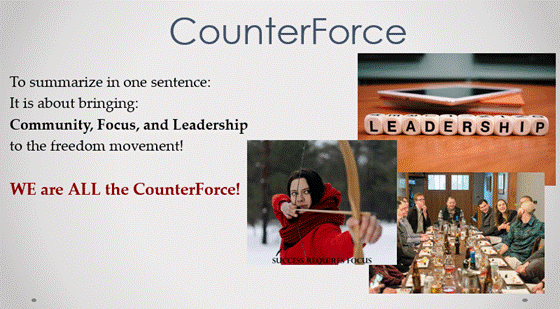
So if I had to boil it down to one sentence: Counterforce is about bringing community, focus, and leadership back to the freedom movement — and not in theory, but in a way that people can actually step into. Because this isn’t something separate from you. This only works because of you. And we’re not building it for people, we’re building it with people, because at the end of the day, we are all the counterforce.
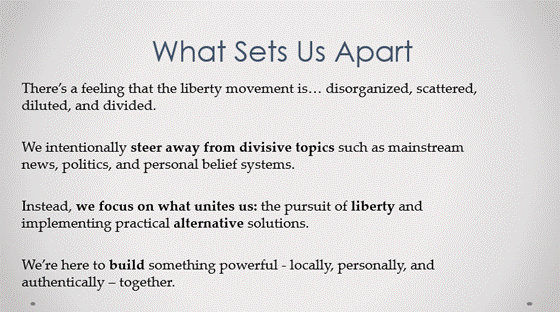
Now, what sets us apart? That’s a good question, and it’s one of the questions we get most often. There’s plenty of other freedom-minded communities and networks out there, so what makes Counterforce Alliance any different? Any of you who have been in the freedom space for more than five minutes have probably felt at times disappointed and frankly let down at the lack of organization within our circles. It’s one of the things I mentioned before, that the other side does way better than us, because, as I said, they’re collectivists whereas we’re mostly radical individualists. We have this sense that the freedom movement is scattered, divided, and hard to plug into. And honestly, that’s not wrong — that’s a valid feeling. What makes Counterforce Alliance different is that we’re not here to add more noise or division. There are plenty of other freedom-minded networks out there, and most of them are just talk or meme-lording — let’s create another meme, that’ll do it. Whereas we build, we empower, we unify, and we intentionally stay away from things that pull us apart and divide us, things like politics and headline news and labels. Instead, we focus on what actually brings people together, which is a shared pursuit of liberty and real, practical solutions. We don’t try to lead for you, we help you lead. And we believe the future of freedom doesn’t come from the top down — it comes from you stepping in, taking action, and leading change in your own life and community. We are here to create a space where leaders and groups can collaborate and grow, and we do that by focusing on what truly matters: personal sovereignty, local resilience, and collective freedom. Because this isn’t just another movement. It is a space to actually build something real together.
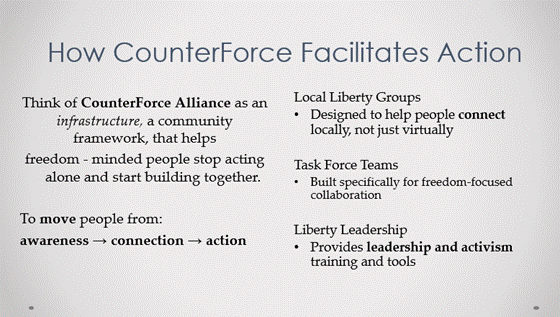
Our community framework — so, how does Counterforce facilitate action? What does the Counterforce community look like in practice? Think of Counterforce as the missing infrastructure, the framework that helps people move from being aware, to connected, to actually taking action. Because the goal isn’t just to inform people — we all know we’re well aware of the problems — it’s to help us build together. And we do that in a few key ways. First, through our local liberty groups, so that people can connect in their own communities, not just online, and turn shared values into relationships and action. Then we have our task force teams, which are focused, collaborative spaces where people come together around specific initiatives and actually get things done. Imagine that. And lastly, we have liberty leadership, giving people the tools, support, and training to step up with confidence and lead in a way that’s sustainable. And all of this is designed to answer that core problem we’ve been talking about: to make sure that no one has to figure this out alone and no effort is wasted.
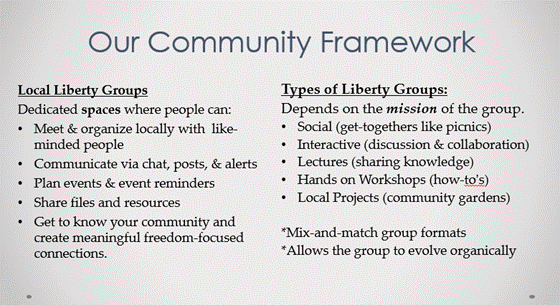
So, our community framework — what does this actually look like on the ground? At the heart of Counterforce is our community framework, and it starts with local liberty groups. These are dedicated spaces where people can actually connect in real life, not just online. I know those in our community value their online privacy, as we all should — that’s really important — but at some point we have to step away and step out from behind the shadow of anonymity, so that we can take the next step of meeting people in real life. We need boots on the ground, so to speak. And this is where, in real life, you can organize, communicate, share resources, plan events, and most importantly, build real relationships with people in your community who care about the same things. Because that’s where trust is built. That’s where the momentum begins. And the beauty of these local liberty groups is that they’re not one-size-fits-all. There are lots of different things you can do with them. These can be social, bringing people together casually for fun meet-and-greets; interactive, centered on discussion and collaboration; educational, sharing knowledge through talks and lectures; or hands-on, building real-world skills or working on local projects. It’s going to evolve naturally as you grow, based on the people, the needs, and the energy of that community. Because we’re not a top-down organization, it’s decentralized. We’re not trying to force a structure onto people or groups, we’re just creating a framework that allows something real to grow. And one example of that is the San Diego Freedom Alliance, which is one of our own local liberty groups. It’s kind of the basis, the genesis, the catalyst of what prompted this whole Counterforce Alliance movement — the success that they’ve had in San Diego organizing their group. They started off as maybe a dozen or a couple dozen people, and they’ve swelled to almost triple digits. They’ve done that by bringing in speakers and hosting conversations on everything from digital privacy, to having people from the Weston A. Price Foundation come in and talk about health and nutrition, to developing real-world activism strategies and doing activism efforts in San Diego. And beyond just activism efforts, it’s about personal growth and development too. They’re offering life-path courses to help people find clarity, purpose, and direction. And they’re also developing practical skills, like time management. So it’s not all heavy. They also intersperse that with fun things, like movie matinees, community gatherings, beach barbecues, shared experiences, and real connection. Because that’s the point. This isn’t just about information. It’s about building relationships, skills, and momentum in a way that actually sticks.
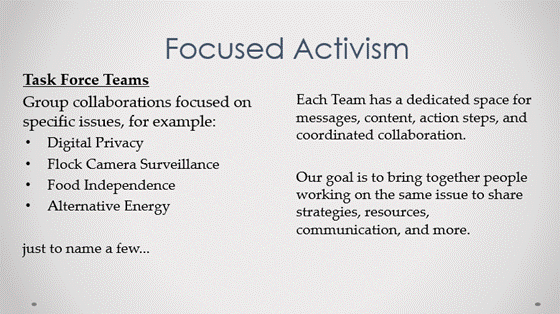
Focused activism. So beyond the local liberty groups, our other secret weapon is our task force teams. And this is where connection starts to turn into real, focused action. Our task force teams are built around specific issues, so people who care about the same thing can stop working in silos and start collaborating. Whether it’s digital privacy, food independence, flock camera surveillance, alternative energy, or emerging issues like data centers and water rights — and that’s a big one, that’s a buzzword these days, these AI data centers — each team has a dedicated space to share research, resources, ideas, and most importantly, coordinated action steps. I’ll give an example. I’m in Florida, the quasi-free state of Florida, at least. What we did last year was make a concerted effort on getting fluoride out of the water in Florida. It started off locally, where we would show up to local city council meetings and commissioner meetings and petition them to start getting fluoride out of the water. That was spurred on by some of the work and attention that RFK Jr. brought to it and his role in the White House, and that helped build some momentum. We were actually having success at that. We were having these county commissioners and city councils start to vote to remove fluoride from the water. That compounded into being able to put forth a bill in our legislature to get the fluoride out of the water at a state level, and ultimately that passed and was signed into law by Governor DeSantis. So this is something that you can replicate on a state-by-state basis. Hey, we’ve had some success there — how can we take that success and let other people know about it? And that’s how we can use these task force teams, so that nobody has to figure it all out on their own. They can take something like Florida and use it as an example and a blueprint, figure out what’s working and what’s not working, which arguments are more persuasive than others. Because that’s one of the biggest gaps we’ve seen: people are working on the same problems, they’re just not working on them together. So the task force teams change that. They bring alignment, clarity, and momentum to making headway on some of these efforts, so the effort is not duplicated, but multiplied. And that’s just the beginning.
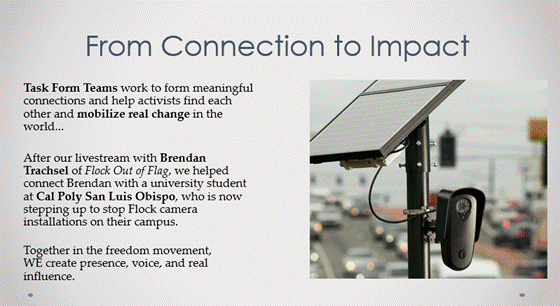
But wait, there’s more. So, from connection to impact. This is where everything starts to come together. Our task force teams don’t just organize ideas, they create real connections between people who are ready to act. And when the right people find each other, things start to move. We’ve already seen this in our Counterforce Alliance community. About a month or two ago, we had a live stream with Brendan Trachsel of Flock Out of Flag, which is an initiative to get flock camera systems out of Flagstaff, Arizona. And he was successful — they actually got them removed. He gave us a great presentation on the step-by-step actions he took to get those flock camera systems out of Flagstaff. And after that live stream, which is on our platform too — you can view it on our platform — we were able to help connect Brendan with a university student at Cal Poly San Luis Obispo. And that connection is already turning into action on their campus to push back against flock camera installations. So that’s how this grows. It’s not a top-down effort, it’s through aligned people finding each other, sharing strategies, and stepping forward together. That’s how we make a difference and have an impact. And the great thing is that that’s just the beginning. So, piggybacking off of that, building the momentum with the flock camera systems, this summer we’re actually going to be actively working to find and connect other student-led groups and local efforts to stop flock at colleges and universities across the country, so that no one is operating in isolation and every effort becomes part of something bigger. Nobody’s starting from square one. We can collaborate and communicate with each other about how we can carry this momentum forward. And that’s what Counterforce Alliance is here for — not just for sharing information, but for helping activists find each other and build something real in the real world.
Stepping into leadership. So this is where it becomes personal at Counterforce. We’re not just here to connect people, we’re also here to help people step into leadership in their own communities. One of the misconceptions about leadership is that it’s about having all the right answers. It just means someone who’s willing to take responsibility for the next step. And the way we support that is through real, practical training — things like how to facilitate a group, how to set expectations, how to delegate and sustain momentum over time. We’ve got courses that are going to help you learn how to do all that. We also provide courses and tools to help you grow in communication, organization, time management, and advocacy, so you’re not just guessing your way through it — you’re supported all the way. If there’s something you don’t know how to do, or maybe you’re a little bit weak on, we’ve probably got a course on it, or we’re creating a course to help you figure out how to do it. But importantly, while all those leadership skills are important, they don’t mean anything if we don’t have the proper value systems to carry them out. So we need to act with integrity. We’re teaching about personal responsibility, truth, and service to others, because those are really the foundations of any free society and the kind of leadership that actually lasts. It doesn’t mean anything to achieve our objectives if we do it by throwing people under the bus and hurting other people. That’s not what we’re about. It’s about how to act with integrity while making headway and momentum for freedom. At Counterforce, we don’t lead for you, we help you lead. And we give you the structure, the support, and the tools to help you step forward and lead. Because at the end of the day, Counterforce was born out of a need for real leadership, direction, and focus, and it grows through people who care about their communities and are ready to take action together.
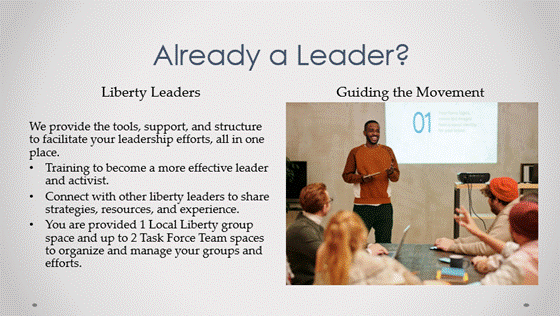
All right, now, there might be some of you on the stream who are already leading. If you’re already a leader, great — that’s awesome, congratulations, thank you for stepping up. So this is where Counterforce becomes a force multiplier for what you’re already doing. If you’ve already taken the step to show up, already taken the steps to organize something and carry responsibility, we’re here to support you and to help you do it more effectively and sustainably. For those who are already leading a local group or specific initiative, we provide you with training that will help you become an even more effective leader and activist, to arm you with the tools, strategies, and skills to keep your group growing and become more resilient. So you’re not just working hard, you’re working more strategically — work smarter, not harder, right? You’ll also be able to connect with other leaders on the network, so you can exchange strategies, resources, and experience with others who are leading alongside you. As a liberty leader, you’ll be provided with the structure needed to be more successful: a dedicated and customizable space on our network to manage your group, including features such as an event calendar, forums, file sharing, members directory, alerts, reminders, and more. You’ll get one space for your local group, and you’ll also get up to two task force team spaces to address specific issues or solutions you are focused on. Because leadership shouldn’t feel like you’re holding everything together on your own. It should feel supported, connected, and built to last.
Our collective impact. All right, what it’s all about here at Counterforce Alliance — our mission is to empower you. Everyone has something unique to offer. Your voice matters. Your skills, your talents, your perspective — they matter now more than ever. And what matters most is choosing not to retreat, not to feel defeatist, not to get blackpilled, but to participate, to step up, to step in and build alongside others who care. Different people, different strengths, coming together with a shared purpose for freedom. And together, we create something far more powerful than any of us could do alone, because it all starts with you.
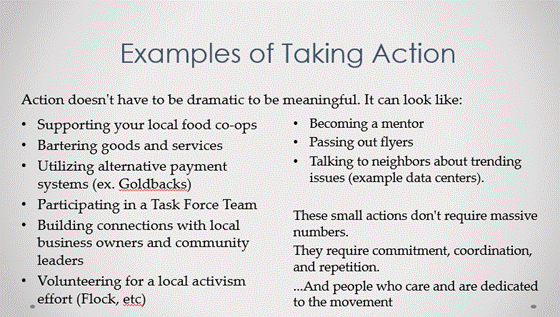
So, some examples of taking action. Action doesn’t have to be big to be meaningful — I think that’s a misconception, and it’s another one of those things that causes hesitation, thinking that in order to be meaningful we have to do something like take down Klaus Schwab at the WEF. I know he’s already been taken down, but that’s just an example. We don’t have to be toppling world leaders in order to take meaningful action. Small actions are just as important. And those small actions can look like things such as supporting a local co-op, growing your own food, bartering for goods and services, showing up to a task force, or simply starting conversations in your community. These are some of the simple, tangible steps that people can take that really make a difference. They really matter, because real change isn’t built on one big moment. And I’ll put this in a quote. If anyone’s ever read The Hobbit by Tolkien, there’s a great quote from Gandalf the Grey, and he says: “Some people believe it is only great power that can hold evil in check. But that is not what I have found. It is the small, everyday deeds of ordinary folk that keep the darkness at bay. Small acts of kindness and love.” And that’s exactly what we can accomplish through our Counterforce Alliance community.
So, moving from isolation to connection, as we close, I want to come back to where we started: that feeling of isolation. If you’ve ever felt like you’ve been carrying this alone, you’re not alone. I’m here to tell you that you’re not alone. Your skills, your voice, your perspective — they’re all needed now more than ever. And Counterforce exists because freedom isn’t meant to be pursued alone. It’s built through connection, through shared effort, through small, steady steps forward. You don’t have to have everything figured out. You don’t need to lead tomorrow. You just need to take the next step. With Counterforce, that isolation becomes community, the hesitation becomes action, and individuals become activists and leaders. So if that resonates with you, we’d be honored to build alongside you.
And there’s no time like the present, as they say. Our time is now. There’s never been a more important moment than right now. You can feel it in the air these days — the tension, the uncertainty, the sense that something’s not right. It’s tangible, it’s palpable. And despite all the promises, not much has truly changed, and if anything, many of our freedoms are slipping faster than we expected. At some point, we have to face reality: no one is coming to save us. Facts. And that’s not meant to create fear, but it is meant to create clarity. Because we’ve seen what happens when we’re unprepared, when we don’t have strong communities, coordination, or a plan. We talked about that with regard to the COVID response. Etienne and his group were prepared, but most of us weren’t. Most of us were the only sane person in an insane asylum, and that led to bad outcomes. And we can’t let that happen again. We can’t be caught unaware, stuck behind the eight ball again. So this is the moment to step forward, to find your people, to take action, however small it may seem. Because silence becomes consent. Every step towards freedom matters. The fear we feel comes from isolation, and the way we defeat that is through action. There is another path forward, and it starts with us. It’s up to all of us to decide what happens next.
So, taking the next step. Are you ready to take action? Are you ready to get off the sideline and get into the game? Are you ready to stop being a keyboard warrior and put some boots on the ground? This is the one area where we want some boots on the ground. Yes, indeed. So if something you’ve heard today resonated, then this is your moment. We want you to join the Counterforce community. Start connecting, engaging, start building. Find a local group or start one. Join a task force that you care about. Step up where you can — every contribution matters. Just take the next step, because consistent, collective action creates real change. And if you’re ready, we’re here. We’re ready to build with you. Your next step starts here.
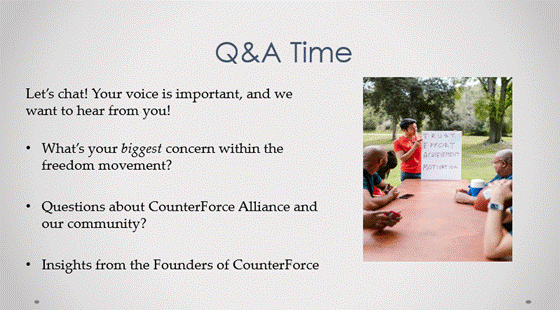
So if you’ve made it this far in the presentation, we really thank you for sticking around. At this point, we are going to open it up to some Q&A. If there have been any questions put in the chat box, we’re going to go through those — we’ve been monitoring the chat. And if you haven’t, now’s your chance to put something in the chat box, maybe something like, what’s your biggest concern or question about our platform, or something personal, like, hey, I’m feeling hopeless or overwhelmed, how can this help? And then we’ll share openly from our side what we’ve learned and what we’re building. So we’re ready to have a conversation. I’m going to kick it over to John, who is the mastermind, the man with the plan, the genius behind all this madness. He and Christina are going to be taking questions and answering all your questions. So John and Christina, if you want to take it over from here.
John: Hi everyone, thanks for joining us. I see a question here about whether or not we have any courses on freedoms. And yes, we have one in the works, and it’s very much in depth. I believe it’s going to change a lot of people’s minds, especially in regard to getting out of the left-right paradigm. Because we, as the Counterforce community, are very much focused on freedom, and party politics just isn’t working, as Etienne has been preaching for years now. So we’re just so happy that he’s brought us on board. And if there are any more questions, we’re here to answer them.
Etienne: Hey, John, while we’re waiting for some questions to appear, could you go ahead and give everybody an overview of what you’ve been able to do in San Diego, some of the success that you’ve had, how that got started, and any best practices that you’ve seen be successful in your group — just a little bit about your group?
John: Sure. Well, our group was started on the Freedom Cell Network, and it was during COVID, right at the beginning. It was actually started by another lady named Sherry. She had some issues in her family, and I just kind of took over to keep the group going, and I’ve been doing it ever since. She just said, John, you’re doing so good, just take over. I said, okay. So it’s been about five years. I do most of the speaking, we do lectures, we have guest speakers, we do some social events, and we just try to mix things up and keep it interesting. So we’ve grown over the years, and people are very happy with what we’ve done. So we’re trying to take what we’ve built over the last five years and get it out to the freedom community. But I’ve learned that keeping things focused on freedom and focused on alternative solutions — that’s what brings people together. We have all different types. We have the whole political spectrum in our group: Democrat, Republican, everything in between, everything outside of the box. They’re all coming to our meetings, they’re all friends, and they’re developing relationships. Some people have changed their politics over the years as we’ve gone through different courses and material we’ve presented. So it’s been a growing process for all of us, and I’m just excited to bring this to the world.
Etienne: And I have been a presenter to the group, so I’m an example of those voices that you’ve been able to bring to the table. If somebody is thinking about doing this in their own community, what would you tell them? What’s the first thing they could do? What’s your best advice for somebody that’s sitting on the fence and would like to do this in their own community?
John: Take our courses. Just kidding. So, start small, start with just your inner circle of friends. If you have no friends that are like-minded to start a group like this, you’re just going to have to go online and see if you can find those people. Go to Etienne’s local groups page, or come to our community, or Freedom Cells, and just try to find your tribe. But if you just start with two people, that’s enough. Just the two of you can meet in a coffee shop, and over time you’re going to meet other people and you can start growing your group. And eventually you can bring in guest speakers. You can mix it up by having social events. We have a Christmas party every year at a nice restaurant, and that’s always a blast. We invite musicians in our group to come and play. Just keep it, like Etienne said, keep it fun, keep it interesting, but you’ve got to keep the focus on freedom and working toward activism efforts too. Otherwise, it’s only a social event. We have members that are highly active in the local community, standing up against the flock cameras, 5G towers, and they’re very successful. So we take what they’ve done and we learn from them, and then we spread that knowledge to everyone else. And then they, in turn, take it to their cities and they can make things turn around for liberty.
Etienne: Christina, do you want to chime in? Do you want to throw out your favorite suggestion for somebody that’s getting started, that wanted to put together a group in their city or town?
Kristina: Yeah. First, I wanted to say what led us to this moment. When John and I first connected and started talking, it became evident very quickly that we both shared a similar vision of creating this way for people to come forward, connect with each other, become more self-reliant, learn the knowledge, learn the skills, get together, and pick their favorite issue and run with it. And I’m very passionate about this project, because I come from a small town, and I know what it’s like to wonder if you’re ever going to find support, if you’re ever going to find your tribe in a small-town community, especially where there just isn’t the numbers or population to support it. So if you’re listening to this and you join our community, we can set you up with your own space for your town, or your region, or wherever you are. And yes, start with a few friends. If not, you might have to start online and contribute to the freedom movement in that way until you can find your tribe that’s locally around you. But in the meantime, we’ve got plenty for you to do. If you want to join us, even small steps — there are ways to contribute to the freedom movement, whatever your skills are, whatever your talents are. We need you, because they’re going to move forward with their agenda. They’re going to keep moving forward as a united front, and we need to do the same. We need to get together. And maybe it isn’t going to be your friends — maybe you’re going to meet them later, once you start, once you create or facilitate a group. And then you post at the library, you post at the coffee shop: hey, are you guys concerned about this? Are you concerned about flock, about biometrics? Let’s get together, let’s talk about growing some food. This is what this is all about. We need to step forward in humanity. We need to step forward and take our rights back and start saying that we’re not going to take this anymore. And the way we do it is together, step by step, big steps, small steps, every walk of life. We need you, we want you to join us, and you’re more than welcome.
Etienne: Well, thank you. Now, is there anything else that you guys — because we’re at the end of our hour — is there anything else that the Counterforce Alliance team would like for folks to know? Or anything that I forgot to ask you? Or anything else that we should cover before we close it out?
Haley: I don’t know if we want to put the last slide up.
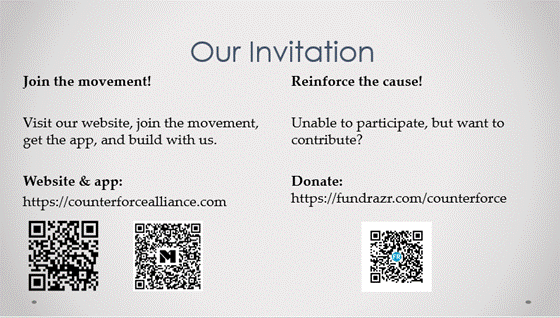
It’s just got our QR codes for where people can find us and how they can join, and our invitation for action: the URL, counterforcealliance.com, and some QR codes that you can scan right now so you can join. It’s free to join, let’s put it that way. There are some membership tiers for those who want to be local liberty leaders and lead task force teams, but anybody can join the platform. And that’s the first logical next step that we want you to take for our movement. It’s not going to hurt you to just start connecting and meeting people and go from there. So, John, anything you want to finish off with about memberships or getting started?
John: I think that one of our core philosophies that I didn’t mention is that we try to focus on people and the local needs. So if you’re starting a group or you want to start an effort, number one, focus on the relationships. That’s the most important thing. If you make it about yourself or your agenda, people are going to see through that. So if you keep it focused on the people you’re working with, it just creates a stronger bond between you. And also, as far as the group as a whole is concerned, keep it about what that area needs or what that area needs to focus on. If flock surveillance is a big issue in your area, then go after it, if that’s what everyone else is on board for. So just keep it about what the other people are interested in as well. You have to give and take. So it’s all about relationships. All right, I hope that helps.
Etienne: Yeah, that was perfect. And I want to thank you guys. I want to thank everybody that joined us. And anybody that sees the live stream, please scan the QR code to get more information: CounterforceAlliance.com, artofliberty.org. You can find our list of liberty groups in your area at: ArtOfLiberty.org/Liberty-Groups/. And I hope everybody takes action. I hope everybody finds their tribe. And I hope everybody has an absolute blast with your new liberty friends and tribe. Thank you for attending. It has been our pleasure to put this together for you.
ArtOfLiberty.org/Liberty-Groups/
The Best “Go Paid” Deal on Substack! You Get REAL Stuff!!

Go paid at the $5 a month level, and we will send you both the PDF and e-Pub versions of Etienne’s new book: To See the Cage Is to Leave It – 25 Techniques the Few Use to Control the Many and a coupon code for 10% off anything in the https://artofliberty.org/store/.
Go paid at the $50 a year level, and we will send you a free paperback edition of Etienne’s new book: To See the Cage Is to Leave It – 25 Techniques the Few Use to Control the Many OR “Government” – The Biggest Scam in History… Exposed! OR a 64GB Liberator flash drive if you live in the US. If you are international, we will give you a $10 credit towards shipping if you agree to pay the remainder.
Support us at the $250 Founding Member Level and get a signed high-resolution hardcover of “Government” – The Biggest Scam in History… Exposed! + Liberator flash drive + a signed high-resolution hardcover of Etienne’s new book: To See the Cage Is to Leave It – 25 Techniques the Few Use to Control the Many + everything else in our “Everything Bundle” of the best in voluntaryist thought delivered domestically. International pays shipping. Our only option for signed copies besides catching Etienne @ an event.The Best “Go Paid” Deal on Substack! You Get REAL Stuff!!