
Bio, Quotes, Memes, Rap Battles and a FREE Paperback Copy of the new book: Hayek for the 21st Century- Essays in Political Economy
The Art of Liberty Foundation is honoring the Nobel Laureate F.A. Hayek, one of the most important economists to have ever lived, with a campaign that will both syndicate the new book: Hayek for the 21st Century – Essays in Political Economy and provide free paperback copies of the book to anyone who goes paid on our Substack as an annual member and/or orders anything from ArtOfLiberty.org/store.
This introduction to F.A. Hayek includes his biography, memes, quotes, “Rap Battles” with economist Lord John Maynard Keynes, and the first installment of our syndication of Hayek for the 21st Century – Essays in Political Economy: The Introduction to the book by Thomas J DiLorenzo, President of the Mises Institute & Editor of Hayek for the 21st Century
We are also adding the full PDF of Hayek for the 21st Century to our uncensorable flash drive of Freedom: The Liberator.
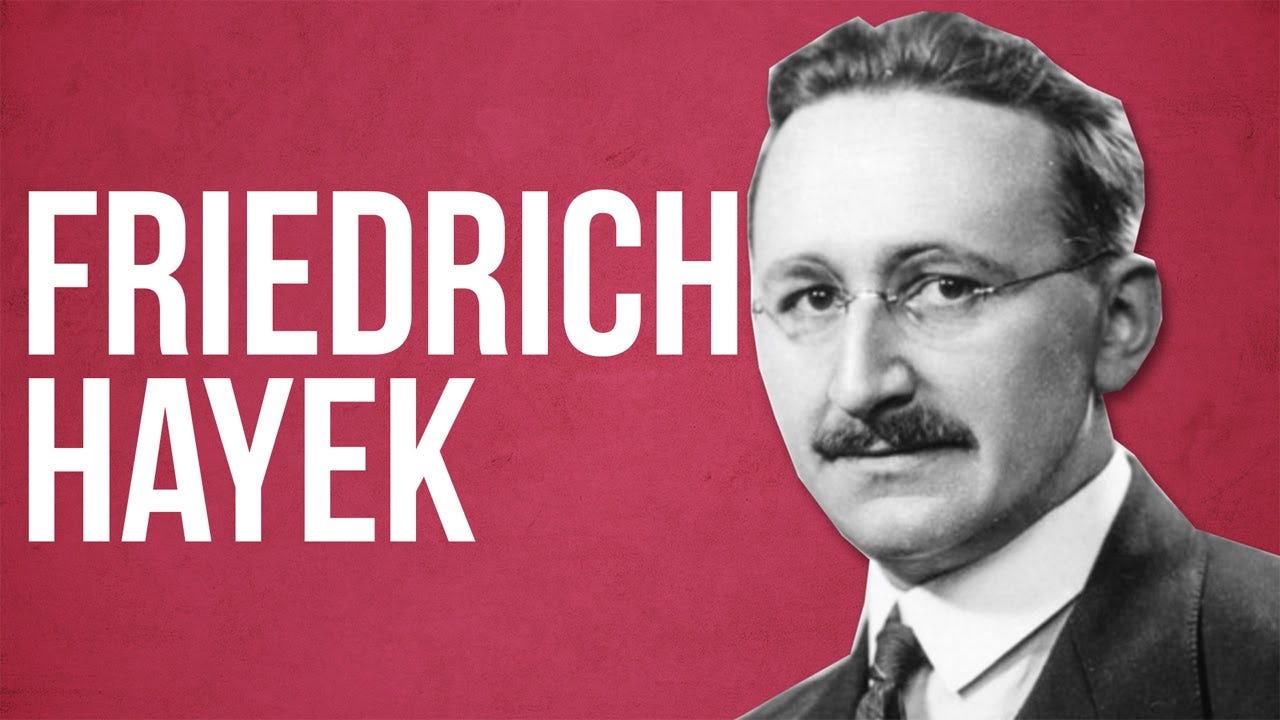
Biography
F. A. Hayek’s life spanned the twentieth century, and he made his home in some of the great intellectual communities of the period.
Born Friedrich August von Hayek in 1899 to a distinguished family of Viennese intellectuals, Hayek attended the University of Vienna, earning doctorates in 1921 and 1923. Hayek came to the University at age 19 just after World War I, when it was one of the three best places in the world to study economics (the others being Stockholm and Cambridge).
Like many students of economics then and since, Hayek chose the subject not for its own sake, but because he wanted to improve social conditions—the poverty of postwar Vienna serving as a daily reminder of such a need. Socialism seemed to provide a solution. Then in 1922 Mises published his Die Gemeinwirtschaft, later translated as Socialism. “To none of us young men who read the book when it appeared,” Hayek recalled, “the world was ever the same again.” It was around this time that Hayek began attending Mises’s famed Privatseminar. For several years the Privatseminar was the center of the economics community in Vienna.
Later, Hayek became the first of this group to leave Vienna; most of the others, along with Mises himself, were also gone by the start of World War II.
At the L.S.E. Hayek lectured on Mises’s business-cycle theory, which he was refining and which, until Keynes’s General Theory came out in 1936, was rapidly gaining adherents in Britain and the U.S. and was becoming the preferred explanation of the Depression. Hayek and Keynes had sparred in the early 1930s in the pages of the Economic Journal, over Keynes’s Treatise on Money.
Within a very few years, however, the fortunes of the Austrian School suffered a dramatic reversal. Mises left Vienna in 1934 for Geneva and then New York, where he continued to work in isolation; Hayek remained at the L.S.E. until 1950, when he joined the Committee on Social Thought at the University of Chicago. Other Austrians of Hayek’s generation became prominent in the U.S. but their work no longer seemed to show distinct traces of the tradition founded by Carl Menger.
At Chicago Hayek again found himself among a dazzling group. But economic theory, in particular its style of reasoning, was rapidly changing. In addition, Hayek had ceased to work on economic theory, concentrating instead on psychology, philosophy, and politics, and Austrian economics entered a prolonged eclipse.
When the 1974 Nobel Prize in economics went to Hayek, interest in the Austrian School was suddenly and unexpectedly revived. Hayek’s writings were taught to new generations, and Hayek himself appeared at the early Institute for Humane Studies conferences in the mid-1970s. He continued to write, producing The Fatal Conceit in 1988, at the age of 89.
Hayek died in 1992 in Freiburg, Germany, where he had lived since leaving Chicago in 1961.
Among mainstream economists, he is mainly known for his popular The Road to Serfdom (1944) and for his work on knowledge in the 1930s and 1940s. Specialists in business cycle theory recognize his early work on industrial fluctuations, and modern information theorists often acknowledge Hayek’s work on prices as signals, although his conclusions are typically disputed. Hayek’s work is also known in political philosophy, legal theory, and psychology.
Within the Austrian School of economics, Hayek’s influence, while undeniably immense, has very recently become the subject of some controversy. His emphasis on spontaneous order and his work on complex systems has been widely influential among many Austrians. Others have preferred to stress Hayek’s work in technical economics, particularly on capital and the business cycle, citing a tension between some of Hayek’s and Mises’s views on the social order.
Hayek’s writings on capital, money, and the business cycle are widely regarded as his most important contributions to economics. Building on Mises’s Theory of Money and Credit (1912), Hayek showed how fluctuations in economy-wide output and employment are related to the economy’s capital structure. In Prices and Production (1931) he introduced the famous “Hayekian triangles” to illustrate the relationship between the value of capital goods and their place in the temporal sequence of production.
In Monetary Theory and the Trade Cycle (1933) Hayek showed how monetary injections, by lowering the rate of interest below what Mises (following Wicksell) called its “natural rate,” distort the economy’s intertemporal structure of production. Most theories of the effects of money on prices and output (then and since) consider only the effects of the total money supply on the price level and aggregate output or investment.
Hayek’s writings on dispersed knowledge and spontaneous order are also widely known, but more controversial. In “Economics and Knowledge” (1937) and “The Use of Knowledge in Society” (1945) Hayek argued that the central economic problem facing society is not, as is commonly expressed in textbooks, the allocation of given resources among competing ends.
It is rather a problem of how to secure the best use of resources known to any of the members of society, for ends whose relative importance only those individuals know. Or, to put it briefly, it is a problem of the utilization of knowledge not given to anyone in its totality.
Clearly, the Austrian revival owes much to Hayek. He ranks among the greatest members of the Austrian School, and among the leading economists of the twentieth century. His work continues to be influential in business cycle theory, comparative economic systems, political and social philosophy, legal theory, and even cognitive psychology. Hayek remains one of the most intriguing intellectual figures of our time.
Fear the Boom and Bust: Keynes vs. Hayek – The Original Economics Rap Battle!
F.A Hayek vs. John Maynard Keynes square off in Fear the Boom and Bust – The Original Economics Rap Battle where Keynes, who advocated “government” action during periods of recession and depression and “wants to steer markets” squares off against F.A Hayek, who advocates for low taxation and savings-led investment by those who best understand their industries… Hayek “wants them set free”
Full Lyrics Here: https://genius.com/John-papola-fear-the-boom-and-bust-hayek-vs-keynes-lyrics
Fight of the Century: Keynes vs. Hayek – Economics Rap Battle Round Two
Full Lyrics Here: https://genius.com/Econstories-fight-of-the-century-lyrics
Which way should we choose?
More bottom-up or more top-down?
The fight continues
Keynes and Hayek, second round
It’s time to weigh in
More from the top or from the ground?
Let’s listen to the greats
Keynes and Hayek throwin’ down
Introduction to Hayek for the 21st Century
Introduction by Thomas J DiLorenzo, President of the Mises Institute & Editor of Hayek for the 21st Century
The rest of Hayek for the 21st Century will be syndicated in the coming weeks.
In a February 7, 2000, article in The New Yorker, journalist John Cassidy wrote that “it is hardly an exaggeration to refer to the twentieth century as the Hayek century.” He said this because of Friedrich Hayek’s prominent role throughout the century in defending free market capitalism and his critiques of socialism, especially his writings on the importance of decentralized knowledge in economic decision-making. Hayek lived to see his ideas proven correct with the worldwide collapse of socialism in the late eighties and early nineties. Watching the images of the collapse on television he said to his son, “I told you so.”
The Knowledge Problem
The “knowledge problem” is Hayek’s key contribution to the critique of socialism. It recognizes the commonsense notion that what makes the economic world go around is the use of knowledge by all kinds of people with diff erent abilities, educations, experiences, and skills. Th anks to this international division of labor and knowledge, we collaborate “as though led by an invisible hand” in order to mutually prosper. It all depends of course on freedom—the freedom to own property, to pursue a profession of your Introduction 7 8 Hayek for the 21st Century choosing, to start and run a business, to buy and sell, to be guided in your decisions by free market prices. By contrast, socialism in all of its varieties is based on the opposite idea—that what is supposedly needed for prosperity is totalitarian powers in the hands of a small number of politicians and “planners” who will forcefully impose a single plan on an entire society. Hayek labeled this “the fatal conceit” of socialism in his last book. Th e entire world now knows that he was right, and all of the socialist tyrants and their propagandists and court historians were (and are) wrong.
Hayek’s “The Use of Knowledge in Society” and “The Pretense of Knowledge,” reprinted here, are the two best expositions of the Hayekian knowledge problem. Indeed, John Cassidy credited Hayek with providing an explanation of the workings of “the information age” of the internet that would develop some fifty years after he first started writing about the importance of decentralized information in society. Th is is not mere speculation on Cassidy’s part. As just one example, the cofounder of Wikipedia, Jimmy Wales, claims to have gotten the idea for Wikipedia as an Auburn University undergraduate finance student aft er Mises Institute Research Fellow Mark Thornton got him to read “The Use of Knowledge in Society.” Hayek called free market capitalism guided by private property and free market prices a “telecommunications system,” which Cassidy suggested was “one of the great insights of the [twentieth] century.”
Hayek’s Demolition of Socialists and Their Ideas
Hayek wrote in a 1961 Southern Economic Journal article (“The Non Sequitur of the ‘Dependence Effect,’” republished here) that for over a hundred years socialists had argued that “the problem of production” had been solved, so that “only the problem of distribution remains.” At the time, the “latest form of this old contention” was in the form of numerous books by the socialist Harvard economist John Kenneth Galbraith, the best known of which was The Affluent Society. Galbraith argued in books and articles that all “essential needs” are already met, and that most of what people think are other “needs” are really fake needs created by the brainwashing effects of advertising. Only “innate” needs that we think of ourselves are useful, said Galbraith; everything else that is brought to our attention by others is therefore useless and wasteful. Therefore, the argument went, government should tax more and spend more for what it deems to be our genuinely useful needs. What is genuinely useful would of course be determined by politicians—presumably with the assistance of John Kenneth Galbraith.
Hayek called this argument “a complete non sequitur.” It implies for one thing that “the whole cultural achievement of man is not important.” The only genuinely innate human needs, said Hayek, are food, shelter, and sex. Everything else is brought to our attention by someone. Hayek’s article is a complete demolition of the Galbraithian system and his life’s work of promoting what Hayek called increasing “the share of the resources whose use is determined by political authority and the coercion of any dissenting minority.”
In 1949 Hayek authored “The Intellectuals and Socialism” in The University of Chicago Law Review. His argument is as relevant today as it was then—if not more relevant. Contrary to the common argument that “intellectuals” have little influence on day-to-day discussions about public policy, Hayek argued that “over somewhat longer periods they have probably never exercised so great an influence as they do today.” He pointed out that socialism was never a “working class” movement but was always hatched from the utopian dreams of “theorists” who spent 10 decades preaching their socialist utopianism in university classrooms and all throughout the culture. In many countries the result of this decades-long propagandizing for socialism was that the views held by socialist intellectuals became “the governing force of politics,” wrote Hayek. The “intellectual” spreaders of socialist ideas were not just academics but also “journalists, teachers, ministers, lecturers, publicists, radio commentators, writers of fiction, cartoonists, and artists,” among many others, including “scientists and doctors.” It is “the intellectuals in this sense who decide what views and opinions are to reach us.”
Eventually, so many institutions are taken over by socialists that an intellectual who espouses the philosophical foundations of a free society, by contrast, “soon discovers that it is unsafe to associate too closely with those who seem to share most of his convictions and he is driven into isolation.” This sounds like a perfect description of today’s American university world. Nevertheless, all is not lost, Hayek concluded. What is needed is education about a classical “liberal Utopia” to counter the endless promises of socialist utopias—not a “diluted kind of socialism,” he wrote, but a “truly liberal radicalism” that does not pull punches to please any special interest group. Leave the compromising to the politicians, he advised.
Hayek was relentless in his devastating critiques of socialism and interventionism, and nowhere is this more on display than in his essay “The Meaning of Competition.” By the 1940s the academic economics profession had adopted a straw-man argument version of competition. Rather than the Austrian School conception of competition as a dynamic, rivalrous discovery process, competition was newly defined as a static situation where “many” business firms all produced a homogeneous product and charged identical prices in a world where all market participants had “perfect knowledge” of everything—what consumers wanted, how to minimize costs and maximize profits, and so on. They called it “perfect competition.” In his essay Hayek explained that “‘perfect’ competition means indeed the absence of all competitive activities” because all of it—product differentiation, price cutting, mergers, advertising—was all assumed away by the perfect competition “model.”
This method of analysis was later labeled a “nirvana fallacy” by UCLA economist Harold Demsetz. Positing a utopian never-never land and comparing it to the real world, and then condemning real-world markets as “failed” because they are “imperfect,” is one of the biggest hoaxes ever perpetrated by the economics profession.
In “Choice in Currency” Hayek did not oppose government issuance of money but instead opposed governmental monopoly and governments’ “power to limit the kinds of money in which contracts may be concluded.” Competing currencies could be valued “in seconds” with “electronic calculators,” Hayek wrote, long before the invention of the cell phone. Competition in currencies would be the path to honest money, for “even the slightest deviation from the path of honesty would reduce the demand for their product.” It is little wonder that Hayek’s writings on competing currencies have become enormously popular among advocates of cryptocurrencies.
Hayekian Political Philosophy
Oddly enough, despite all of his contributions to economic science and his Nobel Prize, what Friedrich Hayek is most known for among the general public is his writings on political philosophy, in particular his infamous book The Road to Serfdom, a critique of collectivism in all its forms. Hayek did not distinguish between fascism and socialism, the former being just a variant of the latter, with a common hatred of private property, free enterprise, economic freedom in general, constitutionalism, and the rule of law. The most famous chapter of The Road to Serfdom is chapter 10, “Why the Worst Get on Top,” republished here. Since any kind of socialism requires a central plan for all of society, it also requires the use of massive governmental force (and censorship of critics) to implement the plan. Consequently, the kind of people who would rise to the top of such a system are those with the fewest qualms about coercing, imprisoning, and brutalizing (or worse) their fellow citizens, wrote Hayek. That is why, he wrote, “the practice of socialism is everywhere totalitarian.”
Hopefully, this brief introduction has helped the reader to understand why the journalist John Cassidy was so inspired by the power of Hayek’s scholarship and writings that he made a case that the entire twentieth century (the good parts of it, anyway) should be thought of as “the Hayek century.” Ludwig von Mises was surely right when, he said that “Doctor Hayek . . . will be remembered as one of the great economists of all time”.
Thomas J. DiLorenzo
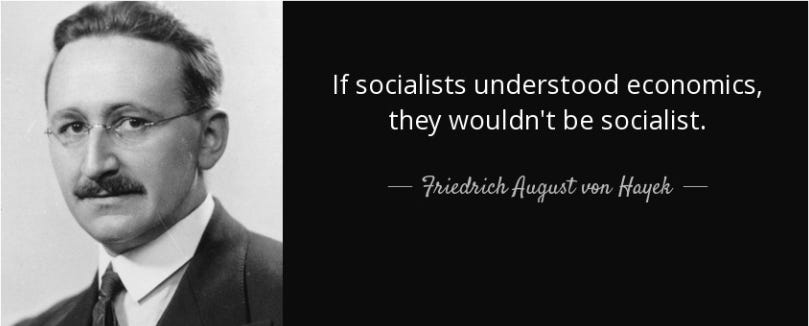
Quotes & Memes
“From the fact that people are very different it follows that, if we treat them equally, the result must be inequality in their actual position, and that the only way to place them in an equal position would be to treat them differently. Equality before the law and material equality are therefore not only different but are in conflict with each other; and we can achieve either one or the other, but not both at the same time”
― Friedrich August von Hayek, Constitution of Liberty
“Fascism is the stage reached after communism has proved an illusion.”
― Friedrich von Hayek
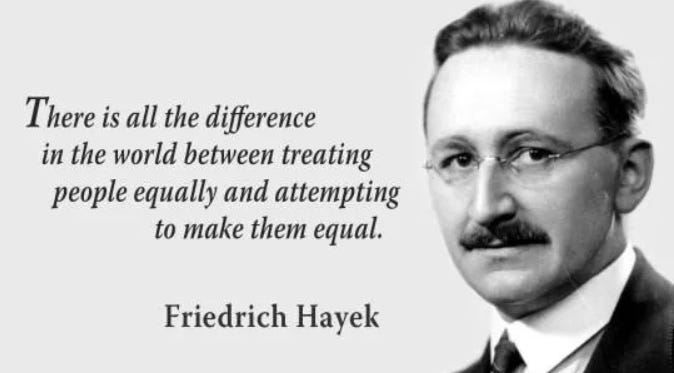
“The argument for liberty is not an argument against organization, which is one of the most powerful tools human reason can employ, but an argument against all exclusive, privileged, monopolistic organization, against the use of coercion to prevent others from doing better.”
― Friedrich August von Hayek, The Constitution of Liberty
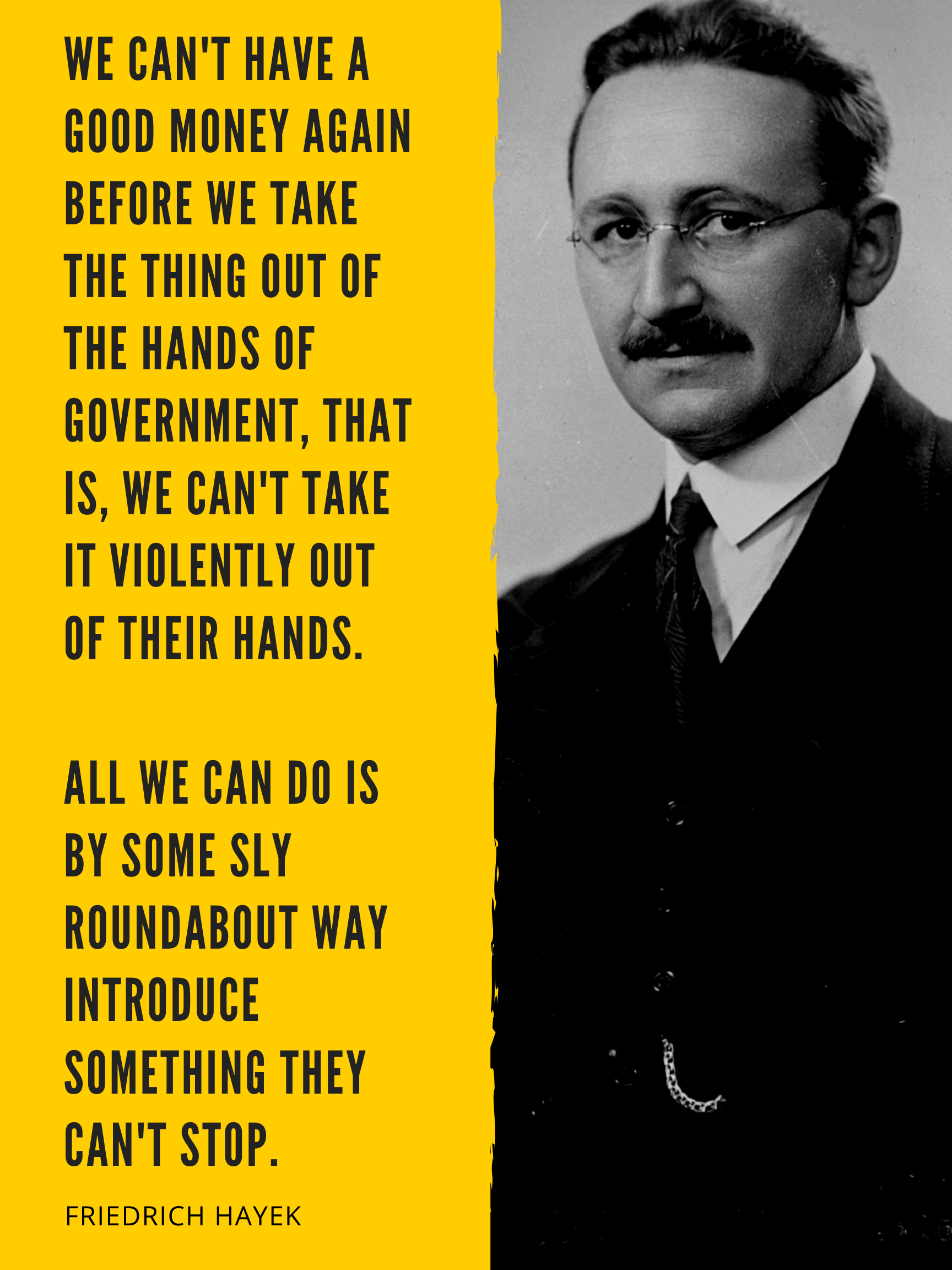
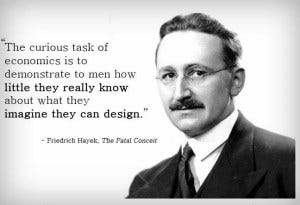
“The curious task of economics is to demonstrate to men how little they really know about what they imagine the can design.”
― F. A. Hayek, The Fatal Conceit: The Errors of Socialism
“Probably it is true enough that the great majority are rarely capable of thinking independently, that on most questions they accept views which they find ready-made, and that they will be equally content if born or coaxed into one set of beliefs or another. In any society freedom of thought will probably be of direct significance only for a small minority. But this does not mean that anyone is competent, or ought to have power, to select those to whom this freedom is to be reserved. It certainly does not justify the presumption of any group of people to claim the right to determine what people ought to think or believe.”
― Friedrich August von Hayek, The Road to Serfdom
“The more the state “plans” the more difficult planning becomes for the individual.”
― Friedrich A. Hayek
“Our freedom of choice in a competitive society rests on the fact that, if one person refuses to satisfy our wishes, we can turn to another. But if we face a monopolist we are at his absolute mercy. And an authority directing the whole economic system of the country would be the most powerful monopolist conceivable…it would have complete power to decide what we are to be given and on what terms. It would not only decide what commodities and services were to be available and in what quantities; it would be able to direct their distributions between persons to any degree it liked.”
― Friedrich August von Hayek, The Road to Serfdom
“It is true that the virtues which are less esteemed and practiced now–independence, self-reliance, and the willingness to bear risks, the readiness to back one’s own conviction against a majority, and the willingness to voluntary cooperation with one’s neighbors–are essentially those on which an individualist society rests. Collectivism has nothing to put in their place, and in so far as it already has destroyed then it has left a void filled by nothing but the demand for obedience and the compulsion of the individual to what is collectively decided to be good.” ― Friedrich August von Hayek, The Road to Serfdom
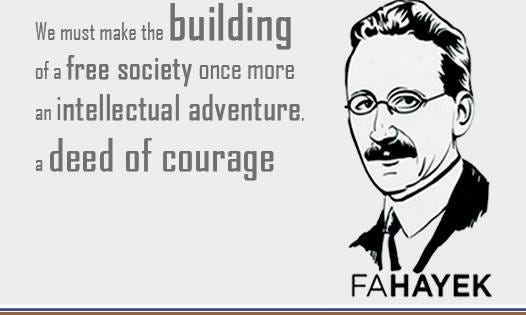
“I am certain, however, that nothing has done so much to destroy the juridical safeguards of individual freedom as the striving after this mirage of social justice.”
― F.A. Hayek
“I was quite depressed two weeks ago when I spent an afternoon at Brentano’s Bookshop in New York and was looking at the kind of books most people read. Once you see that you lose all hope.”
― Friedrich August von Hayek
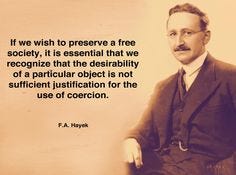
“Emergencies” have always been the pretext on which the safeguards of individual liberty have eroded.”
― Friedrich Hayek
“While an equality of rights under a limited government is possible and an essential condition of individual freedom, a claim for equality of material position can be met only by a government with totalitarian powers.”
― Friedrich A. von Hayek, The Mirage of Social Justice
“Our faith in freedom does not rest on the foreseeable results in particular circumstances but on the belief that it will, on balance, release more forces for the good than for the bad.”
― Friedrich A. Hayek
“The curious task of economics is to demonstrate to men how little they really know about what they imagine they can design. To the naive mind that can conceive of order only as the product of deliberate arrangement, it may seem absurd that in complex conditions order, and adaptation to the unknown, can be achieved more effectively by decentralizing decisions and that a division of authority will actually extend the possibility of overall order. Yet that decentralization actually leads to more information being taken into account.”
― Friedrich Hayek, The Fatal Conceit: The Errors of Socialism

“It is because every individual knows little and, in particular, because we rarely know which of us knows best that we trust the independent and competitive efforts of many to induce the emergence of what we shall want when we see it.”
― Friedrich August von Hayek, The Constitution of Liberty
“From the saintly and single-minded idealist to the fanatic is often but a step.”
― Friedrich A. von Hayek
“It is one of the saddest spectacles of our time to see a great democratic movement support a policy which must lead to the destruction of democracy and which meanwhile can benefit only a minority of the masses who support it. Yet it is this support from the Left of the tendencies toward monopoly which make them so irresistible and the prospects of the future so dark.”
― Friedrich August von Hayek, The Road to Serfdom
“To act on behalf of a group seems to free people of many of the moral restraints which control their behaviour as individuals within the group.”
― Friedrich Hayek, The Road to Serfdom
“Liberty not only means that the individual has both the opportunity and the burden of choice; it also means that he must bear the consequences of his actions and will receive praise or blame for them. Liberty and responsibility are inseparable.”
― Friedrich Hayek, The Constitution of Liberty
“Although we had been warned by some of the greatest political thinkers of the nineteenth century, by Tocqueville and Lord Acton, that socialism means slavery, we have steadily moved in the direction of socialism.”
― Friedrich Hayek, The Road to Serfdom
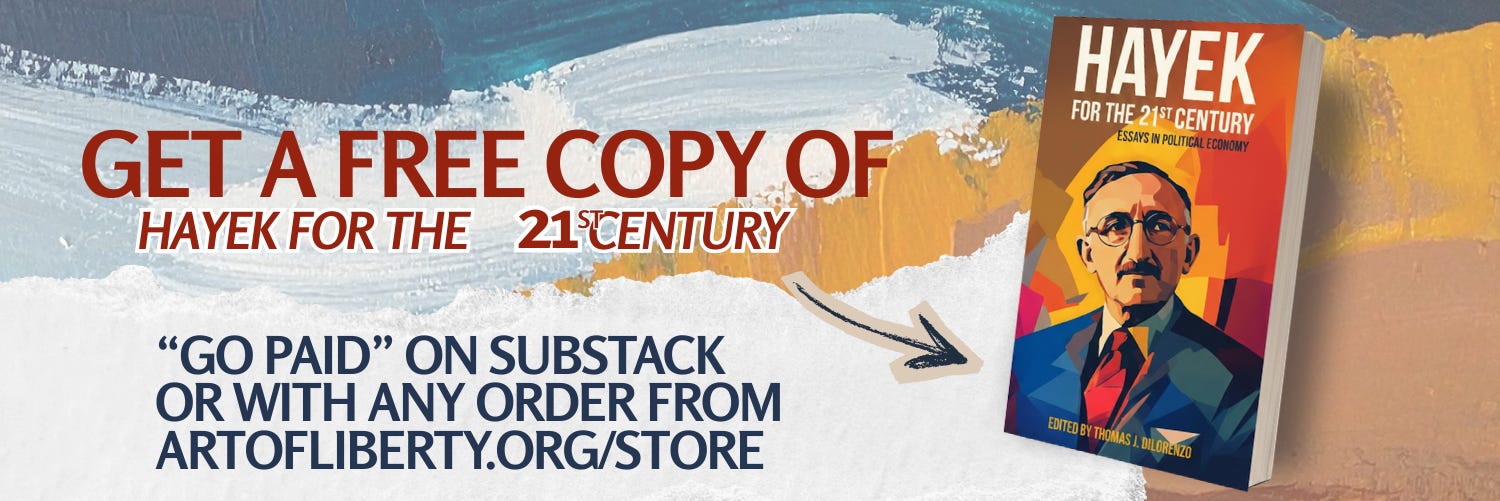
Get a paperback copy of Hayek for the 21st Century for FREE
As part of the Art of Liberty Foundation’s Tribute to Nobel Laureate F.A. Hayek, in cooperation with the Mises Institute and the US Justice Charitable Foundation who provided free copies, the Art of Liberty Foundation is helping promote and distribute the book to anyone who “Goes Paid” as an annual member on Substack OR makes a purchase at ArtOfLiberty.org/Store.
Go paid at the $5 a month level, and we will send you both the PDF and e-Pub versions of Etienne’s new book: To See the Cage Is to Leave It – 25 Techniques the Few Use to Control the Many, the PDF of Hayek for the 21st Century and a coupon code for 10% off anything in the https://artofliberty.org/store/.
Go paid at the $50 a year level, and we will send you a free paperback edition of Etienne’s new book: To See the Cage Is to Leave It – 25 Techniques the Few Use to Control the Many OR “Government” – The Biggest Scam in History… Exposed! OR a 64GB Liberator flash drive PLUS a paperback copy of Hayek for the 21st Century if you live in the US. If you are international, we will give you a $10 credit towards shipping if you agree to pay the remainder.
Support us at the $250 Founding Member Level and get a signed high-resolution hardcover of “Government” – The Biggest Scam in History… Exposed! + Liberator flash drive + a signed high-resolution hardcover of Etienne’s new book: To See the Cage Is to Leave It – 25 Techniques the Few Use to Control the Many PLUS everything else in our “Everything Bundle” of the best in voluntaryist thought PLUS a paperback copy of Hayek for the 21st Century delivered domestically. International pays shipping. Our only option for signed copies besides catching Etienne @ an event.