

Chapter 2 from our FREE paperback book: Hayek for the 21st Century

Etienne Note: This is the 3rd Article in our tribute to the great Austrian Economist Friedrich August von Hayek better known as F.A. Hayek, syndicated from Hayek for the 21st Century, which we are giving away for FREE in paperback through a partnership with the Mises Institute.
In this essay, Why the Worst Get on Top, which is one of the most quoted and controversial sections of The Road to Serfdom (where this essay was originally published) Hayek makes the case that centralized power structures like “government” tend to reward people who are:
-
the most ruthless
-
the least constrained morally
-
the most skilled at propaganda/manipulation
-
the most willing to use coercion
-
the most capable of mobilizing mass resentment
Why the Worst Get on Top became influential because it reframed authoritarianism as not merely a problem of evil individuals, but a systemic selection process.
Hayek’s core arguments:
-
centralized systems require coercion
-
coercion rewards ruthlessness
-
propaganda rewards simplification
-
mass mobilization rewards tribalism
-
moral restraint becomes an obstacle to advancement
This is Chapter Two from Hayek for the 21st Century – Paperback available for Free with any purchase from ArtOfLiberty.org/Store, “Going Paid” on any of our Substacks or by paying S&H for the book. The copies are free thanks to the generosity of a donor to the Mises Institute and they have an offer with free S&H Here.
Previous Chapters from Hayek for the 21st Century:
Introduction by Thomas J DiLorenzo, President of the Mises Institute & Editor of Hayek for the 21st Century + Hayek bio, quotes, rap battles and memes!
Chapter 1: The Intellectuals and Socialism by F.A. Hayek
Why the Worst Get on Top
by F.A. Hayek
All power corrupts, absolute power corrupts absolutely. —Lord Acton
We must now examine a belief from which many who regard the advent of totalitarianism as inevitable derive consolation and which seriously weakens the resistance of many others who would oppose it with all their might if they fully apprehended its nature. It is the belief that the most repellent features of the totalitarian regimes are due to the historical accident that they were established by groups of blackguards and thugs. Surely, it is argued, if in Germany the creation of a totalitarian regime brought the Streichers and Killingers, the Leys and Heines, the Himmlers and Heydrichs to power, this may prove the viciousness of the German character, but not that the rise of such people is the necessary consequence of a totalitarian system. Why should it not be possible that the same sort of system, if it be necessary to achieve important ends, be run by decent people for the good of the community as a whole?
We must not deceive ourselves into believing that all good people must be democrats or will necessarily wish to have a share in the government. Many, no doubt, would rather entrust it to somebody whom they think more competent. Although this might be unwise, there is nothing bad or dishonorable in approving a dictatorship of the good. Totalitarianism, we can already hear it argued, is a powerful system alike for good and evil, and the purpose for which it will be used depends entirely on the dictators. And those who think that it is not the system which we need fear, but the danger that it might be run by bad men, might even be tempted to forestall this danger by seeing that it is established in time by good men.
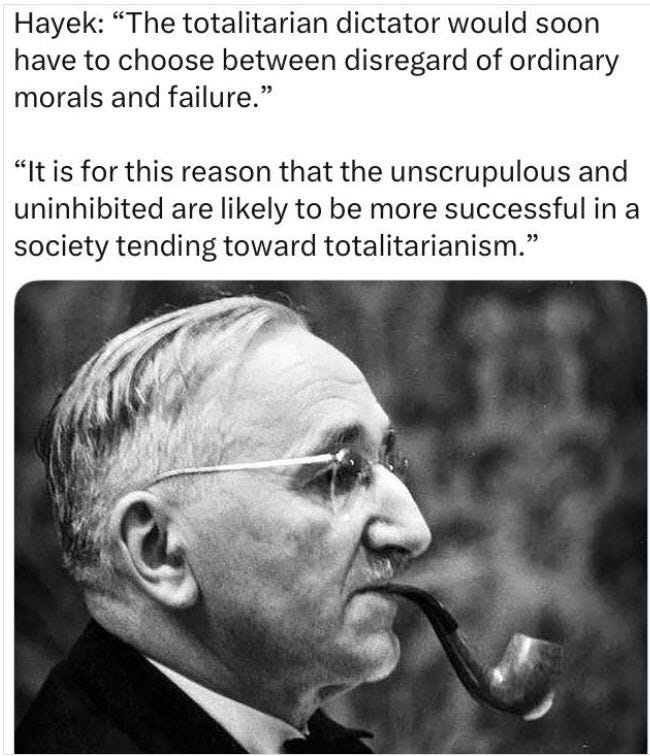
No doubt an English “Fascist” system would greatly differ from the Italian or German models; no doubt if the transition were effected without violence, we might expect to get a better type of leader. And if I had to live under a Fascist system I have no doubt that I would rather live under one run by Englishmen than under one run by anybody else. Yet all this does not mean that, judged on our present standards, a British Fascist system would in the end prove so very different or much less intolerable than its prototypes. There are strong reasons for believing that what to us appear the worst features of the existing totalitarian systems are not accidental by-products, but phenomena which totalitarianism is certain sooner or later to produce. Just as the democratic statesman who sets out to plan economic life will soon be confronted with the alternative of either assuming dictatorial powers or abandoning his plans, so the totalitarian dictator would soon have to choose between disregard of ordinary morals and failure. It is for this reason that the unscrupulous and uninhibited are likely to be more successful in a society tending towards totalitarianism. Who does not see this has not yet grasped the full width of the gulf which separates totalitarianism from a liberal regime, the utter difference between the whole moral atmosphere under collectivism and the essentially individualist Western civilization.

The “moral basis of collectivism” has, of course, been much debated in the past; but what concerns us here is not its moral basis but its moral results. The usual discussions of the ethical aspects of collectivism refer to the question whether collectivism is demanded by existing moral convictions; or what moral convictions would be required if collectivism is to produce the hoped-for results. Our question, however, is what moral views will be produced by a collectivist organization of society, or what views are likely to rule it. The interaction between morals and institutions may well have the effect that the ethics produced by collectivism will be altogether different from the moral ideals that lead to the demand for collectivism. While we are apt to think that, since the desire for a collectivist system springs from high moral motives, such a system must be the breeding ground for the highest virtues, there is, in fact, no reason why any system should necessarily enhance those attitudes which serve the purpose for which it was designed. The ruling moral views will depend partly on the qualities that will lead individuals to success in a collectivist or totalitarian system, and partly on the requirements of the totalitarian machinery.
We must here return for a moment to the position which precedes the suppression of democratic institutions and the creation of a totalitarian regime. In this stage it is the general demand for quick and determined government action that is the dominating element in the situation, dissatisfaction with the slow and cumbersome course of democratic procedure which makes action for action’s sake the goal. It is then the man or the party who seems strong and resolute enough “to get things done” who exercises the greatest appeal. “Strong” in this sense means not merely a numerical majority—it is the ineffectiveness of parliamentary majorities with which people are dissatisfied. What they will seek is somebody with such solid support as to inspire confidence that he can carry out whatever he wants. It is here that the new type of party, organized on military lines, comes in.
In the Central European countries the socialist parties had familiarized the masses with political organizations of a semi-military character designed to absorb as much as possible of the private life of the members. All that was wanted to give one group overwhelming power was to carry the same principle somewhat further, to seek strength not in the assured votes of huge numbers at occasional elections, but in the absolute and unreserved support of a smaller but more thoroughly organized body. The chance of imposing a totalitarian regime on a whole people depends on the leader first collecting round him a group which is prepared voluntarily to submit to that totalitarian discipline which they are to impose by force upon the rest.
Although the socialist parties had the strength to get anything if they had cared to use force, they were reluctant to do so. They had, without knowing it, set themselves a task which only the ruthless, ready to disregard the barriers of accepted morals, can execute.
That socialism can be put into practice only by methods which most socialists disapprove is, of course, a lesson learned by many social reformers in the past. The old socialist parties were inhibited by their democratic ideals; they did not possess the ruthlessness required for the performance of their chosen task. It is characteristic that both in Germany and Italy the success of Fascism was preceded by the refusal of the socialist parties to take over the responsibilities of government. They were unwilling wholeheartedly to employ the methods to which they had pointed the way. They still hoped for the miracle of a majority agreeing on a particular plan for the organization of the whole of society; others had already learned the lesson that in a planned society the question can no longer be on what a majority of the people agree, but what is the largest single group whose members agree sufficiently to make unified direction of all affairs possible; or, if no such group large enough to enforce its views exists, how it can be created and who will succeed in creating it.
There are three main reasons why such a numerous and strong group with fairly homogeneous views is not likely to be formed by the best but rather by the worst elements of any society. By our standards the principles on which such a group would be selected will be almost entirely negative.
In the first instance, it is probably true that in general the higher the education and intelligence of individuals becomes, the more their views and tastes are differentiated and the less likely they are to agree on a particular hierarchy of values. It is a corollary of this that if we wish to find a high degree of uniformity and similarity of outlook, we have to descend to the regions of lower moral and intellectual standards where the more primitive and “common” instincts and tastes prevail. This does not mean that the majority of people have low moral standards; it merely means that the largest group of people whose values are very similar are the people with low standards. It is, as it were, the lowest common denominator which unites the largest number of people. If a numerous group is needed, strong enough to impose their views on the values of life on all the rest, it will never be those with highly differentiated and developed tastes—it will be those who form the “mass” in the derogatory sense of the term, the least original and independent, who will be able to put the weight of their numbers behind their particular ideals.
If, however, a potential dictator had to rely entirely on those whose uncomplicated and primitive instincts happen to be very similar, their number would scarcely give sufficient weight to their endeavors. He will have to increase their numbers by converting more to the same simple creed.
Here comes in the second negative principle of selection: he will be able to obtain the support of all the docile and gullible, who have no strong convictions of their own but are prepared to accept a ready-made system of values if it is only drummed into their ears sufficiently loudly and frequently. It will be those whose vague and imperfectly formed ideas are easily swayed and whose passions and emotions are readily aroused who will thus swell the ranks of the totalitarian party.
It is in connection with the deliberate effort of the skillful demagogue to weld together a closely coherent and homogeneous body of supporters that the third and perhaps most important negative element of selection enters.
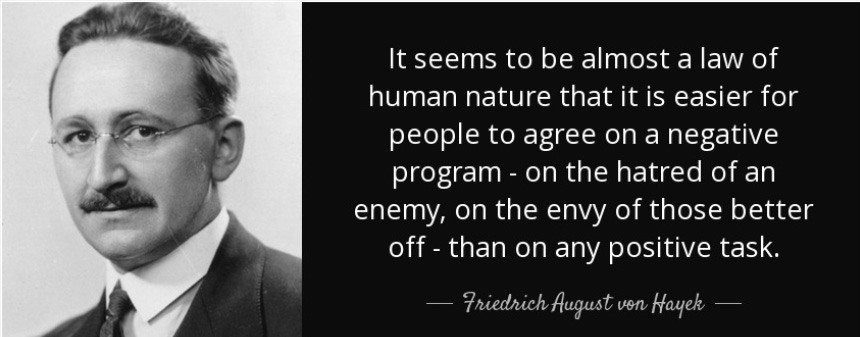
It seems to be almost a law of human nature that it is easier for people to agree on a negative program, on the hatred of an enemy, on the envy of those better off , than on any positive task. The contrast between the “we” and the “they,” the common fight against those outside the group, seems to be an essential ingredient in any creed which will solidly knit together a group for common action.
It is consequently always employed by those who seek, not merely support of a policy, but the unreserved allegiance of huge masses. From their point of view it has the great advantage of leaving them greater freedom of action than almost any positive program. The enemy, whether he be internal like the “Jew” or the “Kulak,” or external, seems to be an indispensable requisite in the armory of a totalitarian leader.
That in Germany it was the Jew who became the enemy till his place was taken by the “plutocracies” was no less a result of the anti-capitalist resentment on which the whole movement was based than the selection of the Kulak in Russia. In Germany and Austria the Jew had come to be regarded as the representative of capitalism because a traditional dislike of large classes of the population for commercial pursuits had left these more readily accessible to a group that was practically excluded from the more highly esteemed occupations. It is the old story of the alien race being admitted only to the less respected trades and then being hated still more for practicing them. The fact that German anti-semitism and anti-capitalism spring from the same root is of great importance for the understanding of what has happened there, but this is rarely grasped by foreign observers.
To treat the universal tendency of collectivist policy to become nationalistic as due entirely to the necessity for securing unhesitating support would be to neglect another and no less important factor. It may indeed be questioned whether anybody can realistically conceive of a collectivist program other than in the service of a limited group, whether collectivism can exist in any other form than that of some kind of particularism, be it nationalism, racialism, or class-ism. The belief in the community of aims and interests with fellow-men seems to presuppose a greater degree of similarity of outlook and thought than exists between men merely as human beings. If the other members of one’s group cannot all be personally known, they must at least be of the same kind as those around us, think and talk in the same way and about the same kind of things, in order that we may identify ourselves with them. Collectivism on a world scale seems to be unthinkable—except in the service of a small ruling elite. It would certainly raise not only technical but above all moral problems which none of our socialists are willing to face. If the English proletarian is entitled to an equal share of the income now derived from England’s capital resources, and of the control of their use, because they are the result of exploitation, so on the same principle all the Indians would be entitled not only to the income from but also to the use of a proportional share of the British capital. But what socialists seriously contemplate the equal division of existing capital resources among the people of the world? They all regard the capital as belonging not to humanity but to the nation—though even within the nation few would dare to advocate that the richer regions should be deprived of some of “their” capital equipment in order to help the poorer regions. What socialists proclaim as a duty towards the fellow members of the existing states, they are not prepared to grant to the foreigner. From a consistent collectivist point of view the claims of the “Have-Not” nations for a new division of the world are entirely justified—though, if consistently applied, those who demand it most loudly would lose by it almost as much as the richest nations. They are, therefore, careful not to base their claims on any equalitarian principles but on their pretended superior capacity to organize other peoples.
One of the inherent contradictions of the collectivist philosophy is, that while basing itself on the humanistic morals which individualism has developed, it is practicable only within a relatively small group. That socialism so long as it remains theoretical is internationalist, while as soon as it is put into practice, whether in Russia or in Germany, it becomes violently nationalist is one of the reasons why “liberal socialism” as most people in the Western world imagine it is purely theoretical, while the practice of socialism is everywhere totalitarian. Collectivism has no room for the wide humanitarianism of liberalism but only for the narrow particularism of the totalitarian.
If the “community” and the state are prior to the individual, if they have ends of their own independent of and superior to those of the individuals, only those individuals who work for the same ends can be regarded as members of the community. It is a necessary consequence of this view that a person is respected only as a member of the group, that is, only if and in so far as he works for the recognized common ends, and that he derives his whole dignity only from this membership and not merely from being man. Indeed, the very concepts of humanity and therefore of any form of internationalism are entirely products of the individualist view of man, and there can be no place for them in a collectivist system of thought.
Apart from the basic fact that the community of collectivism can extend only as far as the unity of purpose of the individuals exists or can be created, several contributory factors strengthen the tendency of collectivism to become particularist and exclusive. Of these one of the most important is that the desire of the individual to identify himself with a group is very frequently the result of a feeling of inferiority, and that therefore his want will only be satisfied if membership in the group confers some superiority over outsiders. Sometimes, it seems, the very fact that these violent instincts which the individual knows he must curb within the group can be given a free range in the collective action towards the outsider becomes a further inducement for merging personality in that of the group. There is a profound truth expressed in the title of R. Niebuhr’s Moral Man and Immoral Society—however little we can follow him in the conclusions he draws from his thesis. There is indeed, as he says elsewhere, “an increasing tendency among modern men to imagine themselves ethical because they have delegated their vices to larger and larger groups.” To act on behalf of a group seems to free people of many of the moral restraints which control their behavior as individuals within the group.
The definitely antagonistic attitude which most planners take towards internationalism is further explained by the fact that in the existing world all outside contacts of a group are obstacles to their effectively planning the sphere in which they can attempt it. It is therefore no accident that, as the editor of one of the most comprehensive collective studies on planning has discovered to his chagrin, “most ‘planners’ are militant nationalists.”
The nationalist and imperialist propensities of socialist planners, much more common than is generally recognized, are not always as flagrant as, for example, in the case of the Webbs and some of the other early Fabians, with whom enthusiasm for planning was characteristically combined with the veneration for the large and powerful political units and a contempt for the small state. The historian Elie Halévy, speaking of the Webbs when he first knew them forty years ago, records that
their socialism was profoundly anti-liberal. They did not hate the Tories, indeed they were extraordinarily lenient to them, but they had no mercy for Gladstonian Liberalism. It was the time of the Boer War and both the advanced liberals and the men who were beginning to form the Labour Party had generously sided with the Boers against British Imperialism, in the name of freedom and humanity. But the two Webbs and their friend, Bernard Shaw, stood apart. They were ostentatiously imperialistic. The independence of small nations might mean something to the liberal individualist. It meant nothing to collectivists like themselves. I can still hear Sidney Webb explaining to me that the future belonged to the great administrative nations, where the officials govern and the police keep order
And elsewhere Halévy quotes Bernard Shaw arguing, about the same time, that “the world is to the big and powerful states by necessity; and the little ones must come within their border or be crushed out of existence.”
I have quoted at length these passages, which would not surprise one in a description of the German ancestors of National Socialism, because they provide so characteristic an example of that glorification of power which easily leads from socialism to nationalism and which profoundly affects the ethical views of all collectivists. So far as the rights of small nations are concerned, Marx and Engels were little better than most other consistent collectivists, and the views they occasionally expressed about Czechs or Poles resemble those of contemporary National Socialists.
While to the great individualist social philosophers of the nineteenth century, to a Lord Acton or Jacob Burckhardt, down to contemporary socialists, like Bertrand Russell, who have inherited the liberal tradition, power itself has always appeared the arch-evil, to the strict collectivist it is a goal in itself. It is not only, as Russell has so well described, that the desire to organize social life according to a unitary plan itself springs largely from a desire for power. It is even more the outcome of the fact that in order to achieve their end collectivists must create power—power over men wielded by other men—of a magnitude never before known, and that their success will depend on the extent to which they achieve such power.
This remains true even though many liberal socialists are guided in their endeavors by the tragic illusion that by depriving private individuals of the power they possess in an individualist system, and by transferring this power to society, they can thereby extinguish power. What all those who argue in this manner overlook is that by concentrating power so that it can be used in the service of a single plan, it is not merely transferred but infinitely heightened; that by uniting in the hands of some single body power formerly exercised independently by many, an amount of power is created infinitely greater than any that existed before, so much more far-reaching as almost to be different in kind.
It is entirely fallacious when it is sometimes argued that the great power exercised by a Central Planning Board would be “no greater than the power collectively exercised by private boards of directors.” There is, in a competitive society, nobody who can exercise even a fraction of the power which a socialist planning board would possess, and if nobody can consciously use the power, it is just an abuse of words to assert that it rests with all the capitalists put together. It is merely a play upon words to speak of the “power collectively exercised by private boards of directors” so long as they do not combine to concerted action—which would, of course, mean the end of competition and the creation of a planned economy. To split or decentralize power is necessarily to reduce the absolute amount of power and the competitive system is the only system designed to minimize by decentralization the power exercised by man over man.
We have seen before how the separation of economic and political aims is an essential guarantee of individual freedom and how it is consequently attacked by all collectivists. To this we must now add that the “substitution of political for economic power” now so often demanded means necessarily the substitution of power from which there is no escape for a power which is always limited. What is called economic power, while it can be an instrument of coercion, is in the hands of private individuals never exclusive or complete power, never power over the whole life of a person. But centralized as an instrument of political power it creates a degree of dependence scarcely distinguishable from slavery.
From the two central features of every collectivist system, the need for a commonly accepted system of ends of the group, and the all-overriding desire to give to the group the maximum of power to achieve these ends, grows a definite system of morals, which on some points coincides and on others violently contrasts with ours— but differs from it in one point which makes it doubtful whether we can call it morals: that it does not leave the individual conscience free to apply its own rules and does not even know any general rules which the individual is required or allowed to observe in all circumstances. This makes collectivist morals so different from what we have known as morals that we find it difficult to discover any principle in them, which they nevertheless possess.
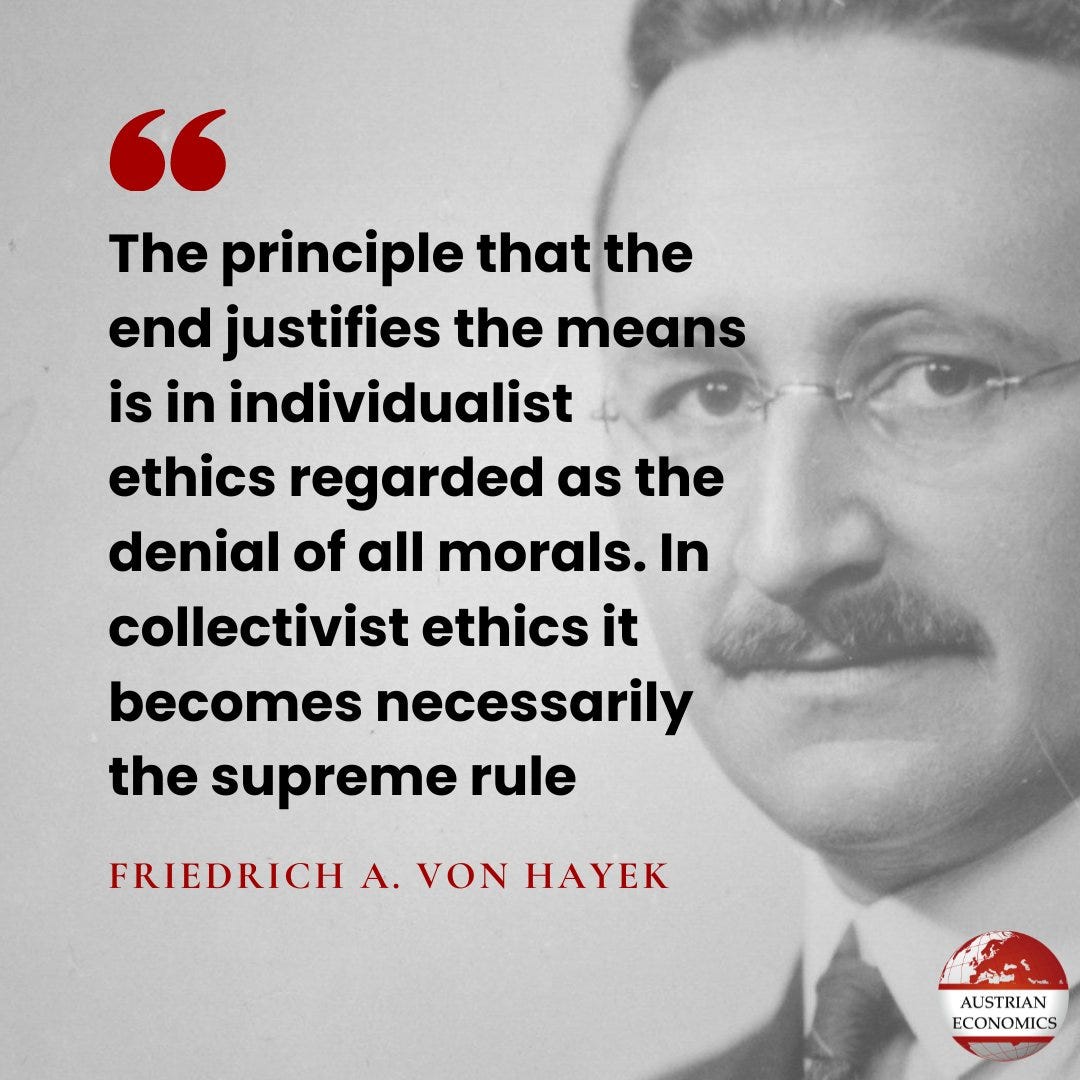
The difference of principle is very much the same as that which we have already considered in connection with the Rule of Law. Like formal law the rules of individualist ethics, however unprecise they may be in many respects, are general and absolute; they prescribe or prohibit a general type of action irrespective of whether in the particular instance the ultimate purpose is good or bad. To cheat or steal, to torture or betray a confidence, is held to be bad, irrespective of whether or not in the particular instance any harm follows from it. Neither the fact that in a given instance nobody may be the worse for it, nor any high purpose for which such an act may have been committed, can alter the fact that it is bad. Though we may sometimes be forced to choose between different evils they remain evils. The principle that the end justifies the means is in individualist ethics regarded as the denial of all morals. In collectivist ethics it becomes necessarily the supreme rule; there is literally nothing which the consistent collectivist must not be prepared to do if it serves “the good of the whole,” because the “good of the whole” is to him the only criterion of what ought to be done. The raison d’état, in which collectivist ethics has found its most explicit formulation, knows no other limit than that set by expediency—the suitability of the particular act for the end in view. And what the raison d’état affirms with respect to the relations between different countries applies equally to the relations between different individuals within the collectivist state. There can be no limit to what its citizen must be prepared to do, no act which his conscience must prevent him from committing, if it is necessary for an end which the community has set itself or which his superiors order him to achieve.
The absence of absolute formal rules in collectivist ethics does not, of course, mean that there are not some useful habits of the individuals which a collectivist community will encourage, and others which it will discourage. Quite the reverse; it will take a much greater interest in the individual’s habits of life than an individualist community. To be a useful member of a collectivist society requires very definite qualities which must be strengthened by constant practice. The reason why we designate these qualities as “useful habits” and can hardly describe them as moral virtues is that the individual could never be allowed to put these rules above any definite orders, or to let them become an obstacle to the achievement of any of the particular aims of his community. They only serve, as it were, to fill any gaps which direct orders or the designation of particular aims may leave, but they can never justify a conflict with the will of the authority.
The differences between the virtues which will continue to be esteemed under a collectivist system and those which will disappear is well illustrated by a comparison of the virtues which even their worst enemies admit the Germans, or rather the “typical Prussian,” to possess, and those of which they are commonly thought lacking and in which the English people, with some justification, used to pride themselves as excelling. Few people will deny that the Germans on the whole are industrious and disciplined, thorough and energetic to the degree of ruthlessness, conscientious and single-minded in any tasks they undertake, that they possess a strong sense of order, duty, and strict obedience to authority, and that they often show great readiness to make personal sacrifices and great courage in physical danger. All these make the German an efficient instrument in carrying out an assigned task, and they have accordingly been carefully nurtured in the old Prussian state and the new Prussian-dominated Reich. What the “typical German” is often thought to lack are the individualist virtues of tolerance and respect for other individuals and their opinions, of independence of mind and that uprightness of character and readiness to defend one’s own convictions against a superior which the Germans themselves, usually conscious that they lack it, call Zivilcourage, of consideration for the weak and infirm, and of that healthy contempt and dislike of power which only an old tradition of personal liberty creates. Deficient they seem also in most of those little yet so important qualities which facilitate the intercourse between men in a free society: kindliness and a sense of humor, personal modesty, and respect for the privacy and belief in the good intentions of one’s neighbor.
After what we have already said it will not cause surprise that these individualist virtues are at the same time eminently social virtues, virtues which smooth social contacts and which make control from above less necessary and at the same time more difficult. They are virtues which flourish wherever the individualist or commercial type of society has prevailed and which are missing according as the collectivist or military type of society predominates—a difference which is, or was, as noticeable between the various regions of Germany as it has now become between the views which rule in Germany and those characteristic of the West. Till recently, at least, in those parts of Germany which have been longest exposed to the civilizing forces of commerce, the old commercial towns of the south and west and the Hanse towns, the general moral concepts were probably much more akin to those of the Western people than to those which have now become dominant all over Germany.
It would, however, be highly unjust to regard the masses of the totalitarian people as devoid of moral fervor because they give unstinted support to a system which to us seems a denial of most moral values. For the great majority of them the opposite is probably true: the intensity of the moral emotions behind a movement like that of National Socialism or communism can probably be compared only to those of the great religious movements of history. Once you admit that the individual is merely a means to serve the ends of the higher entity called society or the nation, most of those features of totalitarian regimes which horrify us follow of necessity. From the collectivist standpoint intolerance and brutal suppression of dissent, the complete disregard of the life and happiness of the individual, are essential and unavoidable consequences of this basic premise, and the collectivist can admit this and at the same time claim that his system is superior to one in which the “selfish” interests of the individual are allowed to obstruct the full realization of the ends the community pursues. When German philosophers again and again represent the striving for personal happiness as itself immoral and only the fulfillment of an imposed duty as praiseworthy, they are perfectly sincere, however difficult this may be to understand for those who have been brought up in a different tradition.
Where there is one common all-overriding end there is no room for any general morals or rules. To a limited extent we ourselves experience this in wartime. But even war and the greatest peril had led in this country only to a very moderate approach to totalitarianism, very little setting aside of all other values in the service of a single purpose. But where a few specific ends dominate the whole of society, it is inevitable that occasionally cruelty may become a duty, that acts which revolt all our feeling, such as the shooting of hostages or the killing of the old or sick, should be treated as mere matters of expediency, that the compulsory uprooting and transportation of hundreds of thousands should become an instrument of policy approved by almost everybody except the victims, or that suggestions like that of a “conscription of women for breeding purposes” can be seriously contemplated. There is always in the eyes of the collectivist a greater goal which these acts serve and which to him justifies them because the pursuit of the common end of society can know no limits in any rights or values of any individual.
But while for the mass of the citizens of the totalitarian state it is often unselfish devotion to an ideal, although one that is repellent to us, which makes them approve and even perform such deeds, this cannot be pleaded for those who guide its policy. To be a useful assistant in the running of a totalitarian state it is not enough that a man should be prepared to accept specious justification of vile deeds; he must himself be prepared actively to break every moral rule he has ever known if this seems necessary to achieve the end set for him. Since it is the supreme leader who alone determines the ends, his instruments must have no moral convictions of their own. They must, above all, be unreservedly committed to the person of the leader; but next to this the most important thing is that they should be completely unprincipled and literally capable of everything. They must have no ideals of their own which they want to realize, no ideas about right or wrong which might interfere with the intentions of the leader. There is thus in the positions of power little to attract those who hold moral beliefs of the kind which in the past have guided the European peoples, little which could compensate for the distastefulness of many of the particular tasks, and little opportunity to gratify any more idealistic desires, to recompense for the undeniable risk, the sacrifice of most of the pleasures of private life and of personal independence which the posts of great responsibility involve. The only tastes which are satisfied are the taste for power as such, the pleasure of being obeyed and of being part of a well-functioning and immensely powerful machine to which everything else must give way.
Yet while there is little that is likely to induce men who are good by our standards to aspire to leading positions in the totalitarian machine, and much to deter them, there will be special opportunities for the ruthless and unscrupulous. There will be jobs to be done about the badness of which taken by themselves nobody has any doubt, but which have to be done in the service of some higher end, and which have to be executed with the same expertness and efficiency as any others. And as there will be need for actions which are bad in themselves, and which all those still influenced by traditional morals will be reluctant to perform, the readiness to do bad things becomes a path to promotion and power. The positions in a totalitarian society in which it is necessary to practice cruelty and intimidation, deliberate deception and spying, are numerous. Neither the Gestapo nor the administration of a concentration camp, neither the Ministry of Propaganda nor the SA or SS (or their Italian or Russian counterparts) are suitable places for the exercise of humanitarian feelings. Yet it is through positions like these that the road to the highest positions in the totalitarian state leads. It is only too true when a distinguished American economist concludes from a similar brief enumeration of the duties of the authorities of a collectivist state that
they would have to do these things whether they wanted to or not: and the probability of the people in power being individuals who would dislike the possession and exercise of power is on a level with the probability that an extremely tender hearted person would get the job of whipping-master in a slave plantation.
We cannot, however, exhaust this subject here. The problem of the selection of the leaders is closely bound up with the wide problem of selection according to the opinions held, or rather according to the readiness with which a person conforms to an ever-changing set of doctrines. And this leads us to one of the most characteristic moral features of totalitarianism, its relation to, and its effect on, all the virtues falling under the general heading of truthfulness. This is so big a subject that it requires a separate chapter.

The Art of Liberty Foundation is honoring the Nobel Laureate F.A. Hayek, one of the most important economists to have ever lived, with a campaign that will both syndicate the new book: Hayek for the 21st Century – Essays in Political Economy and provide free paperback copies of the book to anyone who goes paid on our Substack as an annual member and/or orders anything from ArtOfLiberty.org/store.
This introduction to F.A. Hayek includes his biography, memes, quotes, “Rap Battles” with economist Lord John Maynard Keynes, and the first installment of our syndication of Hayek for the 21st Century – Essays in Political Economy: The Introduction to the book by Thomas J DiLorenzo, President of the Mises Institute & Editor of Hayek for the 21st Century
We are also adding the full PDF of Hayek for the 21st Century to our uncensorable flash drive of Freedom: The Liberator.
Biography
F. A. Hayek’s life spanned the twentieth century, and he made his home in some of the great intellectual communities of the period.
Born Friedrich August von Hayek in 1899 to a distinguished family of Viennese intellectuals, Hayek attended the University of Vienna, earning doctorates in 1921 and 1923. Hayek came to the University at age 19 just after World War I, when it was one of the three best places in the world to study economics (the others being Stockholm and Cambridge).
Like many students of economics then and since, Hayek chose the subject not for its own sake, but because he wanted to improve social conditions—the poverty of postwar Vienna serving as a daily reminder of such a need. Socialism seemed to provide a solution. Then in 1922 Mises published his Die Gemeinwirtschaft, later translated as Socialism. “To none of us young men who read the book when it appeared,” Hayek recalled, “the world was ever the same again.” It was around this time that Hayek began attending Mises’s famed Privatseminar. For several years the Privatseminar was the center of the economics community in Vienna.
Later, Hayek became the first of this group to leave Vienna; most of the others, along with Mises himself, were also gone by the start of World War II.
At the L.S.E. Hayek lectured on Mises’s business-cycle theory, which he was refining and which, until Keynes’s General Theory came out in 1936, was rapidly gaining adherents in Britain and the U.S. and was becoming the preferred explanation of the Depression. Hayek and Keynes had sparred in the early 1930s in the pages of the Economic Journal, over Keynes’s Treatise on Money.
Within a very few years, however, the fortunes of the Austrian School suffered a dramatic reversal. Mises left Vienna in 1934 for Geneva and then New York, where he continued to work in isolation; Hayek remained at the L.S.E. until 1950, when he joined the Committee on Social Thought at the University of Chicago. Other Austrians of Hayek’s generation became prominent in the U.S. but their work no longer seemed to show distinct traces of the tradition founded by Carl Menger.
At Chicago Hayek again found himself among a dazzling group. But economic theory, in particular its style of reasoning, was rapidly changing. In addition, Hayek had ceased to work on economic theory, concentrating instead on psychology, philosophy, and politics, and Austrian economics entered a prolonged eclipse.
When the 1974 Nobel Prize in economics went to Hayek, interest in the Austrian School was suddenly and unexpectedly revived. Hayek’s writings were taught to new generations, and Hayek himself appeared at the early Institute for Humane Studies conferences in the mid-1970s. He continued to write, producing The Fatal Conceit in 1988, at the age of 89.
Hayek died in 1992 in Freiburg, Germany, where he had lived since leaving Chicago in 1961.
Among mainstream economists, he is mainly known for his popular The Road to Serfdom (1944) and for his work on knowledge in the 1930s and 1940s. Specialists in business cycle theory recognize his early work on industrial fluctuations, and modern information theorists often acknowledge Hayek’s work on prices as signals, although his conclusions are typically disputed. Hayek’s work is also known in political philosophy, legal theory, and psychology.
Within the Austrian School of economics, Hayek’s influence, while undeniably immense, has very recently become the subject of some controversy. His emphasis on spontaneous order and his work on complex systems has been widely influential among many Austrians. Others have preferred to stress Hayek’s work in technical economics, particularly on capital and the business cycle, citing a tension between some of Hayek’s and Mises’s views on the social order.
Hayek’s writings on capital, money, and the business cycle are widely regarded as his most important contributions to economics. Building on Mises’s Theory of Money and Credit (1912), Hayek showed how fluctuations in economy-wide output and employment are related to the economy’s capital structure. In Prices and Production (1931) he introduced the famous “Hayekian triangles” to illustrate the relationship between the value of capital goods and their place in the temporal sequence of production.
In Monetary Theory and the Trade Cycle (1933) Hayek showed how monetary injections, by lowering the rate of interest below what Mises (following Wicksell) called its “natural rate,” distort the economy’s intertemporal structure of production. Most theories of the effects of money on prices and output (then and since) consider only the effects of the total money supply on the price level and aggregate output or investment.
Hayek’s writings on dispersed knowledge and spontaneous order are also widely known, but more controversial. In “Economics and Knowledge” (1937) and “The Use of Knowledge in Society” (1945) Hayek argued that the central economic problem facing society is not, as is commonly expressed in textbooks, the allocation of given resources among competing ends.
It is rather a problem of how to secure the best use of resources known to any of the members of society, for ends whose relative importance only those individuals know. Or, to put it briefly, it is a problem of the utilization of knowledge not given to anyone in its totality.
Clearly, the Austrian revival owes much to Hayek. He ranks among the greatest members of the Austrian School, and among the leading economists of the twentieth century. His work continues to be influential in business cycle theory, comparative economic systems, political and social philosophy, legal theory, and even cognitive psychology. Hayek remains one of the most intriguing intellectual figures of our time.
Fear the Boom and Bust: Keynes vs. Hayek – The Original Economics Rap Battle!
F.A Hayek vs. John Maynard Keynes square off in Fear the Boom and Bust – The Original Economics Rap Battle where Keynes, who advocated “government” action during periods of recession and depression and “wants to steer markets” squares off against F.A Hayek, who advocates for low taxation and savings-led investment by those who best understand their industries… Hayek “wants them set free”
Full Lyrics Here: https://genius.com/John-papola-fear-the-boom-and-bust-hayek-vs-keynes-lyrics
Fight of the Century: Keynes vs. Hayek – Economics Rap Battle Round Two
Full Lyrics Here: https://genius.com/Econstories-fight-of-the-century-lyrics
Which way should we choose?
More bottom-up or more top-down?
The fight continues
Keynes and Hayek, second round
It’s time to weigh in
More from the top or from the ground?
Let’s listen to the greats
Keynes and Hayek throwin’ down
Introduction to Hayek for the 21st Century
Introduction by Thomas J DiLorenzo, President of the Mises Institute & Editor of Hayek for the 21st Century
The rest of Hayek for the 21st Century will be syndicated in the coming weeks.
In a February 7, 2000, article in The New Yorker, journalist John Cassidy wrote that “it is hardly an exaggeration to refer to the twentieth century as the Hayek century.” He said this because of Friedrich Hayek’s prominent role throughout the century in defending free market capitalism and his critiques of socialism, especially his writings on the importance of decentralized knowledge in economic decision-making. Hayek lived to see his ideas proven correct with the worldwide collapse of socialism in the late eighties and early nineties. Watching the images of the collapse on television he said to his son, “I told you so.”
The Knowledge Problem
The “knowledge problem” is Hayek’s key contribution to the critique of socialism. It recognizes the commonsense notion that what makes the economic world go around is the use of knowledge by all kinds of people with different abilities, educations, experiences, and skills. Thanks to this international division of labor and knowledge, we collaborate “as though led by an invisible hand” in order to mutually prosper. It all depends of course on freedom—the freedom to own property, to pursue a profession of your Introduction 7 8 Hayek for the 21st Century choosing, to start and run a business, to buy and sell, to be guided in your decisions by free market prices. By contrast, socialism in all of its varieties is based on the opposite idea—that what is supposedly needed for prosperity is totalitarian powers in the hands of a small number of politicians and “planners” who will forcefully impose a single plan on an entire society. Hayek labeled this “the fatal conceit” of socialism in his last book. The entire world now knows that he was right, and all of the socialist tyrants and their propagandists and court historians were (and are) wrong.
Hayek’s “The Use of Knowledge in Society” and “The Pretense of Knowledge,” reprinted here, are the two best expositions of the Hayekian knowledge problem. Indeed, John Cassidy credited Hayek with providing an explanation of the workings of “the information age” of the internet that would develop some fifty years after he first started writing about the importance of decentralized information in society. This is not mere speculation on Cassidy’s part. As just one example, the cofounder of Wikipedia, Jimmy Wales, claims to have gotten the idea for Wikipedia as an Auburn University undergraduate finance student aft er Mises Institute Research Fellow Mark Thornton got him to read “The Use of Knowledge in Society.” Hayek called free market capitalism guided by private property and free market prices a “telecommunications system,” which Cassidy suggested was “one of the great insights of the [twentieth] century.”
Hayek’s Demolition of Socialists and Their Ideas
Hayek wrote in a 1961 Southern Economic Journal article (“The Non Sequitur of the ‘Dependence Effect,’” republished here) that for over a hundred years socialists had argued that “the problem of production” had been solved, so that “only the problem of distribution remains.” At the time, the “latest form of this old contention” was in the form of numerous books by the socialist Harvard economist John Kenneth Galbraith, the best known of which was The Affluent Society. Galbraith argued in books and articles that all “essential needs” are already met, and that most of what people think are other “needs” are really fake needs created by the brainwashing effects of advertising. Only “innate” needs that we think of ourselves are useful, said Galbraith; everything else that is brought to our attention by others is therefore useless and wasteful. Therefore, the argument went, government should tax more and spend more for what it deems to be our genuinely useful needs. What is genuinely useful would of course be determined by politicians—presumably with the assistance of John Kenneth Galbraith.
Hayek called this argument “a complete non sequitur.” It implies for one thing that “the whole cultural achievement of man is not important.” The only genuinely innate human needs, said Hayek, are food, shelter, and sex. Everything else is brought to our attention by someone. Hayek’s article is a complete demolition of the Galbraithian system and his life’s work of promoting what Hayek called increasing “the share of the resources whose use is determined by political authority and the coercion of any dissenting minority.”
In 1949 Hayek authored “The Intellectuals and Socialism” in The University of Chicago Law Review. His argument is as relevant today as it was then—if not more relevant. Contrary to the common argument that “intellectuals” have little influence on day-to-day discussions about public policy, Hayek argued that “over somewhat longer periods they have probably never exercised so great an influence as they do today.” He pointed out that socialism was never a “working class” movement but was always hatched from the utopian dreams of “theorists” who spent 10 decades preaching their socialist utopianism in university classrooms and all throughout the culture. In many countries the result of this decades-long propagandizing for socialism was that the views held by socialist intellectuals became “the governing force of politics,” wrote Hayek. The “intellectual” spreaders of socialist ideas were not just academics but also “journalists, teachers, ministers, lecturers, publicists, radio commentators, writers of fiction, cartoonists, and artists,” among many others, including “scientists and doctors.” It is “the intellectuals in this sense who decide what views and opinions are to reach us.”
Eventually, so many institutions are taken over by socialists that an intellectual who espouses the philosophical foundations of a free society, by contrast, “soon discovers that it is unsafe to associate too closely with those who seem to share most of his convictions and he is driven into isolation.” This sounds like a perfect description of today’s American university world. Nevertheless, all is not lost, Hayek concluded. What is needed is education about a classical “liberal Utopia” to counter the endless promises of socialist utopias—not a “diluted kind of socialism,” he wrote, but a “truly liberal radicalism” that does not pull punches to please any special interest group. Leave the compromising to the politicians, he advised.
Hayek was relentless in his devastating critiques of socialism and interventionism, and nowhere is this more on display than in his essay “The Meaning of Competition.” By the 1940s the academic economics profession had adopted a straw-man argument version of competition. Rather than the Austrian School conception of competition as a dynamic, rivalrous discovery process, competition was newly defined as a static situation where “many” business firms all produced a homogeneous product and charged identical prices in a world where all market participants had “perfect knowledge” of everything—what consumers wanted, how to minimize costs and maximize profits, and so on. They called it “perfect competition.” In his essay Hayek explained that “‘perfect’ competition means indeed the absence of all competitive activities” because all of it—product differentiation, price cutting, mergers, advertising—was all assumed away by the perfect competition “model.”
This method of analysis was later labeled a “nirvana fallacy” by UCLA economist Harold Demsetz. Positing a utopian never-never land and comparing it to the real world, and then condemning real-world markets as “failed” because they are “imperfect,” is one of the biggest hoaxes ever perpetrated by the economics profession.
In “Choice in Currency” Hayek did not oppose government issuance of money but instead opposed governmental monopoly and governments’ “power to limit the kinds of money in which contracts may be concluded.” Competing currencies could be valued “in seconds” with “electronic calculators,” Hayek wrote, long before the invention of the cell phone. Competition in currencies would be the path to honest money, for “even the slightest deviation from the path of honesty would reduce the demand for their product.” It is little wonder that Hayek’s writings on competing currencies have become enormously popular among advocates of cryptocurrencies.
Hayekian Political Philosophy
Oddly enough, despite all of his contributions to economic science and his Nobel Prize, what Friedrich Hayek is most known for among the general public is his writings on political philosophy, in particular his infamous book The Road to Serfdom, a critique of collectivism in all its forms. Hayek did not distinguish between fascism and socialism, the former being just a variant of the latter, with a common hatred of private property, free enterprise, economic freedom in general, constitutionalism, and the rule of law. The most famous chapter of The Road to Serfdom is chapter 10, “Why the Worst Get on Top,” republished here. Since any kind of socialism requires a central plan for all of society, it also requires the use of massive governmental force (and censorship of critics) to implement the plan. Consequently, the kind of people who would rise to the top of such a system are those with the fewest qualms about coercing, imprisoning, and brutalizing (or worse) their fellow citizens, wrote Hayek. That is why, he wrote, “the practice of socialism is everywhere totalitarian.”
Hopefully, this brief introduction has helped the reader to understand why the journalist John Cassidy was so inspired by the power of Hayek’s scholarship and writings that he made a case that the entire twentieth century (the good parts of it, anyway) should be thought of as “the Hayek century.” Ludwig von Mises was surely right when, he said that “Doctor Hayek . . . will be remembered as one of the great economists of all time”.
Thomas J. DiLorenzo
Quotes & Memes
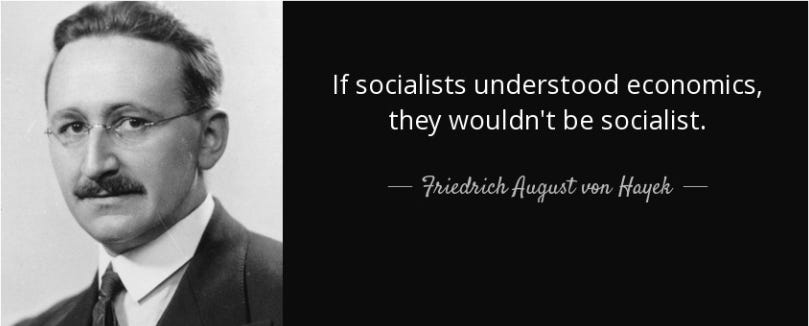
“From the fact that people are very different it follows that, if we treat them equally, the result must be inequality in their actual position, and that the only way to place them in an equal position would be to treat them differently. Equality before the law and material equality are therefore not only different but are in conflict with each other; and we can achieve either one or the other, but not both at the same time”
― Friedrich August von Hayek, Constitution of Liberty
“Fascism is the stage reached after communism has proved an illusion.”
― Friedrich von Hayek
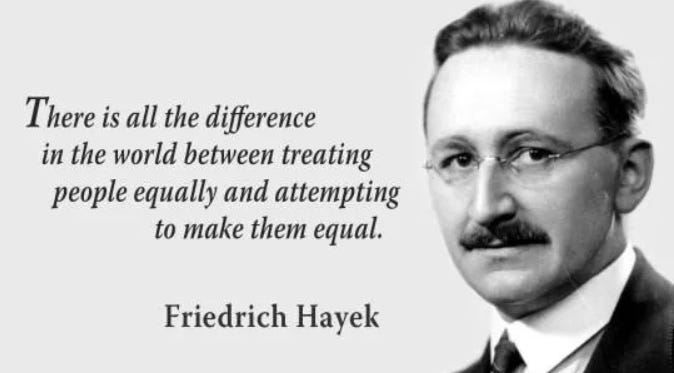
“The argument for liberty is not an argument against organization, which is one of the most powerful tools human reason can employ, but an argument against all exclusive, privileged, monopolistic organization, against the use of coercion to prevent others from doing better.”
― Friedrich August von Hayek, The Constitution of Liberty
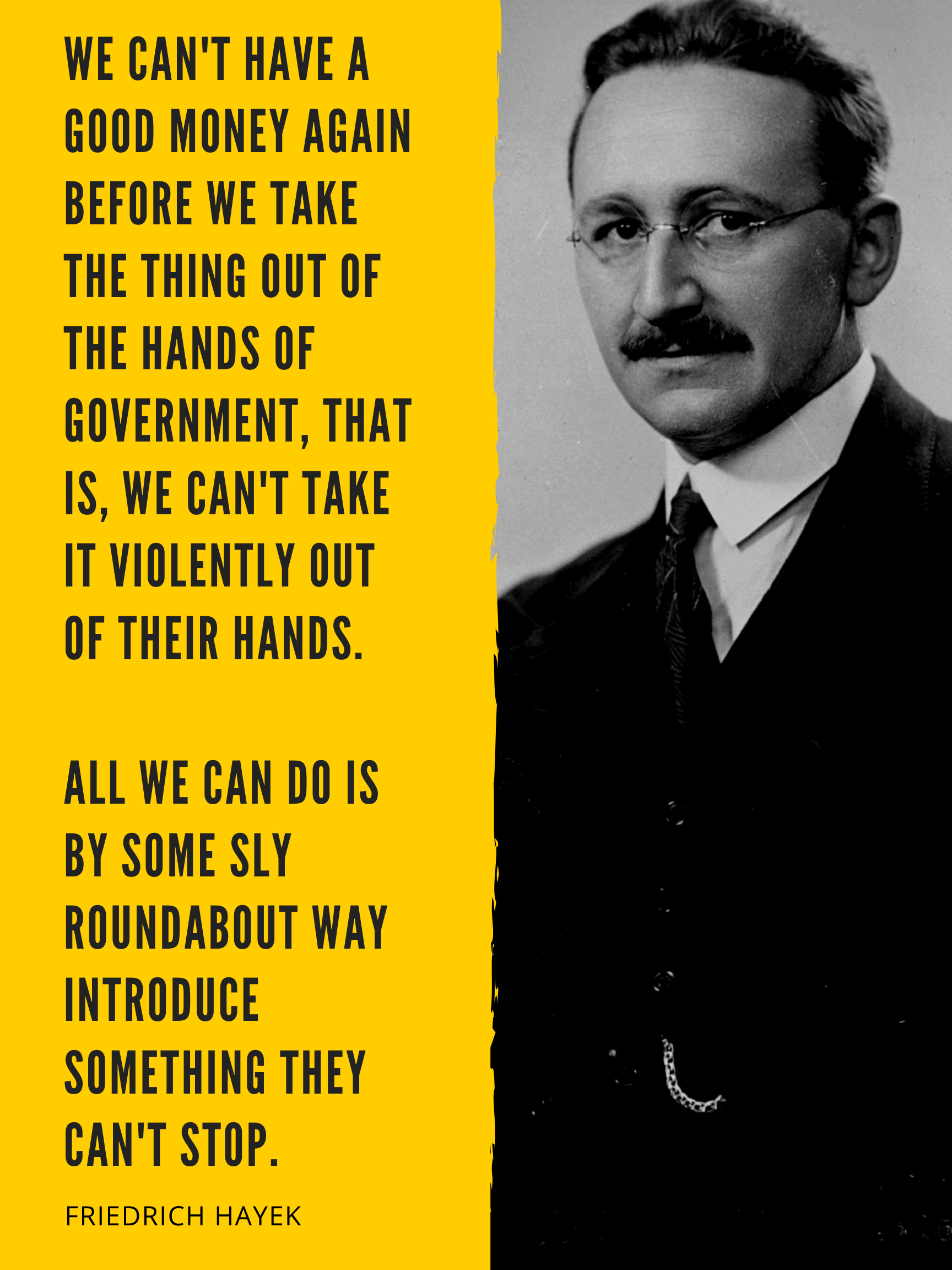
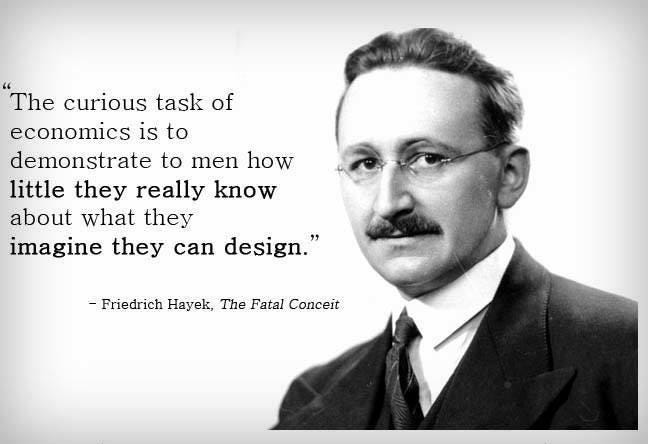
“The curious task of economics is to demonstrate to men how little they really know about what they imagine the can design.”
― F. A. Hayek, The Fatal Conceit: The Errors of Socialism
“Probably it is true enough that the great majority are rarely capable of thinking independently, that on most questions they accept views which they find ready-made, and that they will be equally content if born or coaxed into one set of beliefs or another. In any society freedom of thought will probably be of direct significance only for a small minority. But this does not mean that anyone is competent, or ought to have power, to select those to whom this freedom is to be reserved. It certainly does not justify the presumption of any group of people to claim the right to determine what people ought to think or believe.”
― Friedrich August von Hayek, The Road to Serfdom
“The more the state “plans” the more difficult planning becomes for the individual.”
― Friedrich A. Hayek
“Our freedom of choice in a competitive society rests on the fact that, if one person refuses to satisfy our wishes, we can turn to another. But if we face a monopolist we are at his absolute mercy. And an authority directing the whole economic system of the country would be the most powerful monopolist conceivable…it would have complete power to decide what we are to be given and on what terms. It would not only decide what commodities and services were to be available and in what quantities; it would be able to direct their distributions between persons to any degree it liked.”
― Friedrich August von Hayek, The Road to Serfdom
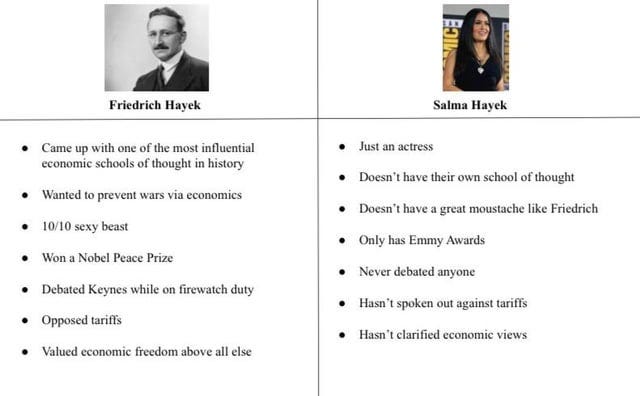
“It is true that the virtues which are less esteemed and practiced now–independence, self-reliance, and the willingness to bear risks, the readiness to back one’s own conviction against a majority, and the willingness to voluntary cooperation with one’s neighbors–are essentially those on which an individualist society rests. Collectivism has nothing to put in their place, and in so far as it already has destroyed then it has left a void filled by nothing but the demand for obedience and the compulsion of the individual to what is collectively decided to be good.” ― Friedrich August von Hayek, The Road to Serfdom

“I am certain, however, that nothing has done so much to destroy the juridical safeguards of individual freedom as the striving after this mirage of social justice.”
― F.A. Hayek
“I was quite depressed two weeks ago when I spent an afternoon at Brentano’s Bookshop in New York and was looking at the kind of books most people read. Once you see that you lose all hope.”
― Friedrich August von Hayek
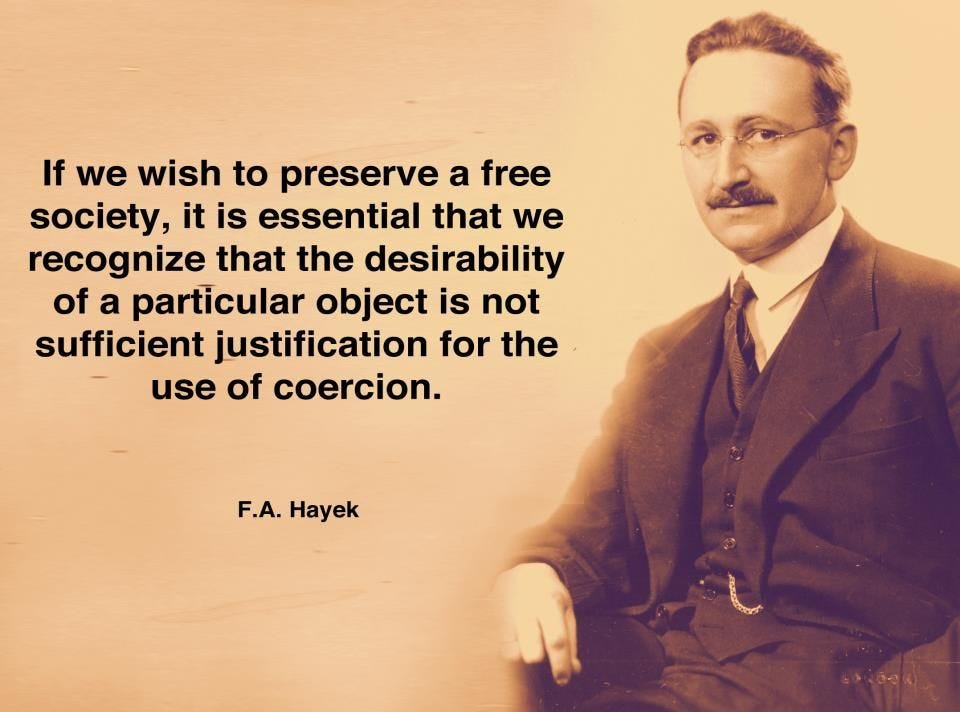
“Emergencies” have always been the pretext on which the safeguards of individual liberty have eroded.”
― Friedrich Hayek
“While an equality of rights under a limited government is possible and an essential condition of individual freedom, a claim for equality of material position can be met only by a government with totalitarian powers.”
― Friedrich A. von Hayek, The Mirage of Social Justice
“Our faith in freedom does not rest on the foreseeable results in particular circumstances but on the belief that it will, on balance, release more forces for the good than for the bad.”
― Friedrich A. Hayek
“The curious task of economics is to demonstrate to men how little they really know about what they imagine they can design. To the naive mind that can conceive of order only as the product of deliberate arrangement, it may seem absurd that in complex conditions order, and adaptation to the unknown, can be achieved more effectively by decentralizing decisions and that a division of authority will actually extend the possibility of overall order. Yet that decentralization actually leads to more information being taken into account.”
― Friedrich Hayek, The Fatal Conceit: The Errors of Socialism

“It is because every individual knows little and, in particular, because we rarely know which of us knows best that we trust the independent and competitive efforts of many to induce the emergence of what we shall want when we see it.”
― Friedrich August von Hayek, The Constitution of Liberty
“From the saintly and single-minded idealist to the fanatic is often but a step.”
― Friedrich A. von Hayek
“It is one of the saddest spectacles of our time to see a great democratic movement support a policy which must lead to the destruction of democracy and which meanwhile can benefit only a minority of the masses who support it. Yet it is this support from the Left of the tendencies toward monopoly which make them so irresistible and the prospects of the future so dark.”
― Friedrich August von Hayek, The Road to Serfdom
“To act on behalf of a group seems to free people of many of the moral restraints which control their behaviour as individuals within the group.”
― Friedrich Hayek, The Road to Serfdom
“Liberty not only means that the individual has both the opportunity and the burden of choice; it also means that he must bear the consequences of his actions and will receive praise or blame for them. Liberty and responsibility are inseparable.”
― Friedrich Hayek, The Constitution of Liberty
“Although we had been warned by some of the greatest political thinkers of the nineteenth century, by Tocqueville and Lord Acton, that socialism means slavery, we have steadily moved in the direction of socialism.”
― Friedrich Hayek, The Road to Serfdom
Get a paperback copy of Hayek for the 21st Century for FREE
As part of the Art of Liberty Foundation’s Tribute to Nobel Laureate F.A. Hayek, in cooperation with the Mises Institute and the US Justice Charitable Foundation who provided free copies, the Art of Liberty Foundation is helping promote and distribute the book to anyone who “Goes Paid” as an annual member on Substack OR makes a purchase at ArtOfLiberty.org/Store.

Go paid at the $5 a month level, and we will send you both the PDF and e-Pub versions of Etienne’s new book: To See the Cage Is to Leave It – 25 Techniques the Few Use to Control the Many, the PDF of Hayek for the 21st Century and a coupon code for 10% off anything in the https://artofliberty.org/store/.
Go paid at the $50 a year level, and we will send you a free paperback edition of Etienne’s new book: To See the Cage Is to Leave It – 25 Techniques the Few Use to Control the Many OR “Government” – The Biggest Scam in History… Exposed! OR a 64GB Liberator flash drive PLUS a paperback copy of Hayek for the 21st Century if you live in the US. If you are international, we will give you a $10 credit towards shipping if you agree to pay the remainder.
Support us at the $250 Founding Member Level and get a signed high-resolution hardcover of “Government” – The Biggest Scam in History… Exposed! + Liberator flash drive + a signed high-resolution hardcover of Etienne’s new book: To See the Cage Is to Leave It – 25 Techniques the Few Use to Control the Many PLUS everything else in our “Everything Bundle” of the best in voluntaryist thought PLUS a paperback copy of Hayek for the 21st Century delivered domestically. International pays shipping. Our only option for signed copies besides catching Etienne @ an event.